Thursday, April 30, 2015

For Friends Who Say They Miss Me On Facebook

What we’re watching and listening to at our house:

THE LIVE KITTEN CAM

This is a live video feed of a mama cat and five kittens (now three days old) at a rescue in British Columbia. We’ve been running this on the TV when we’re not using it for anything else. We have learned from this that it is possible to be unable to tear yourself away from a screen on which five kittens are doing nothing but sleep.

Me, texting our housemate C yesterday: “We have a live feed of 2-day-old kittens on the TV.”

10 seconds later, their dog Winnie comes thundering up the stairs, closely followed by C, who pauses in the kitchen doorway and says, “This is relevant to my interests,” before plopping down on the couch.

THE MOUNTAIN GOATS, THE LIFE OF THE WORLD TO COME: TRACK 2

I had never heard of The Mountain Goats until my friend Chandra put one of their songs on a mixtape for me a few months ago, but I liked that one song enough that I've been listening to their other stuff as well. The Life of the World to Come is a 2009 album of songs based on Bible verses. I’m being pretty well blown away by it, though it’s taking me a long time to get to know the album because I keep getting caught up in listening to the same song on repeat for awhile before I can move on. Right now the song that has me driving home the long way to hear it one more time is "Psalm 40:2." (Link goes to song, not Bible verse.)

When I was teaching creative writing, one of the biggest challenges was Christian students turning in reams of cliches and dead language. It’s not only because I’m a Quaker that I don’t think it’s worth writing a poem if it’s just a weak re-tread of imagery from the NIV. This is true of much Christian music as well, I find: it’s not bad, it’s just not at all fresh. I think that’s why I like a song like Old Crow Medicine Show’s “Firewater,” off their last album, which does something really interesting with the imagery of communion.

So one thing I’m liking about The Life of the World to Come is that John Darnielle is so good at doing interesting things with the biblical language and contemporary settings. "Psalm 40:2” starts:

Pulled off the highway in Missouri,
Lo our hearts were heavy laden.

This song makes me want to drive to Julie’s house, bang wildly on her door, wave the CD in her bewildered face and yell, “OH MY GOD JULIE YOU HAVE TO HEAR THIS SONG!” like we are enthusiastic teenagers. Because Darnielle could hardly have written a better Dean Winchester theme song if he’d tried. Again I link to the song because it is best listened to. But here are the lyrics. They’re good lyrics, but perhaps only Julie will think, “Wow, yeah, Su is so right about this song!” and join me in fantasizing about creating a fanvid set to it. 

Pulled off the highway in Missouri, Lo our hearts were heavy laden.
Made for the chapel with some spray paint for all the things we’d held in secret.
Lord, lift up these lifeless bones.
Light cascading through the windows, all the rainbow’s heavy tones.

He has fixed his sign in the sky;
He has raised me from the pit and set me high.

Left that place in ruin, drunk on the Spirit and high on fumes,
Checked into a Red Roof Inn, stayed up for several hours
and then slept like infants in the burning fuselage of my days.
Let my mouth be ever fresh with praise.

He has fixed his sign in the sky;
He has raised me from the pit and set me high.

Each morning new; each day shot through
with all the sharp small shards of shrapnel that seem to burst out of me and you.

Head down toward Kansas, we will get there when we get there, don’t you worry.
Feel bad about the things we do along the way, but not really that bad.

We inhaled the frozen air.
Lord, send me a mechanic if I’m not beyond repair.

He has fixed his sign in the sky;
He has raised me from the pit and he will set me high.

In an interview I read while googling for lyrics confirmation (though bless John Darnielle for his clean enunciation), the interviewer says, “I couldn’t tell if it was a song about a crime spree or just a really seedy road trip,” and Darnielle says, “Well, you know, I don’t want to say it’s this or that, but both of those are in the right neighborhood,” and I thought, “Ha, he doesn’t want to admit he’s been watching Supernatural.” Only the Red Roof inn doesn’t fit, because Sam and Dean would never stay at a chain motel. Back me up here, Jules.

It’s actually a good interview, worth reading. Darnielle says, “If you’re into music, you’re into religion, some way or another,” and he says, “What is it like to feel as though you’re covered in God’s grace, even when you’re doing things like desecrating a chapel?” and he says, “One way you can get really close to God is to sin as hard as you can.”

THE MOUNTAIN GOATS, THE LIFE OF THE WORLD TO COME: TRACK 11

The other song I have really spent a lot of time with is “Isaiah 45:23.” It has been a real comfort to me. This past year, since my pain has gotten so much worse, I have been profoundly discouraged. I haven’t been suicidal, but I have sometimes felt burdened by life. Unable to reconcile myself to my diminishments. Afraid that it would get to be too much for David, and there would be no one to care for me at the times when I can’t care for myself. The only time in my life I have ever regretted having children is at these moments when I resent the way they tie me to life for the duration of their childhoods; when, more accurately, I live in fear of failing them. I’ve never actively considered suicide, and I’ve never been self-destructive the way I’ve seen friends who are toying with the idea be, but I have now and again felt that I would not much regret a fast-growing cancer or an unfortunate patch of ice on a dark highway.

This song should not be comforting, and it probably wouldn’t have been if I’d heard it for the first time a few months ago. I think it could only be a comfort now that I am feeling a bit better, emotionally at least: I have a capacity to be comforted, now, which I think I did not have over the winter.

Anyway. The song is about old age, but it speaks to me as a person with chronic pain. As is always true with music, the song is more than just its lyrics, so if you’re interested I recommend listening to it. But the first verse and chorus go like this:

If my prayer be not humble, make it so.
If these last hours the spirit waits in check, help me let it go.
And should my suffering double, let me never love you less.
Let every knee be bent; let every tongue confess.

And I won’t get better, but some day I’ll be free.
Cause I am not this body that imprisons me.

I’ve never been one for the “at least we’ll be free in death” model of religious comfort, but right now, accompanied by a very mellow acoustic guitar, it works for me.

THE VIEW OUT THE WINDOW

While I was writing this, a male cardinal was hunting out the best tidbits on the ground under the feeder and feeding them to his mate. It made me very happy. It seemed like a thing that was worth being alive for. A few months ago I’d have scoffed at the idea; I’d have called it paltry, and the worst kind of false comfort, to suggest that five minutes of watching birds woo could be enough validate the whole enterprise of living. But sometimes it is. I am glad to be alive to see those cardinals.

THE JOHN ADAMS MINISERIES

Yesterday, someone posted this question at AskMetafilter: “How did you come to terms with your chronic pain?” I was drawn to the thread, of course, but for the most part I found it too painful to read; right now, I have very much not come to terms with my pain. But in what I did read, a couple of people talked about trying not to fight it too hard; one person said, "I kind of have workaholic tendencies. Being too sick to work led to me making my peace with playing video games and watching movies and doing the things I could do, even if they weren't the things I felt I should be doing or wanted to be doing.” Another said, "Give yourself a certain point of experiencing pain and then say, 'fuck it. I'm binge watching X' and do whatever makes you feel comfortable.”

I’ve been enjoying having time off from school, and having few other commitments, though I sometimes fret that I’m wasting my days. I feel that I'm not fighting hard enough against my pain. I should be doing more with the Older Two, I think, who have been so neglected; I have taken to thinking of myself as an unschooler again, if only to paste a not-very-convincing bandaid over my failures as a homeschooler. And yet, at the same time, I don’t think it’s a bad thing to be catching up on movies and TV shows; it’s a form of exploration I haven’t had much time for in years. And it’s exploration that can be done from the couch, and paused when the need to nap comes over me suddenly and irresistibly, as it tends to do. Word Boy watches with me, much of the time; we've gotten even closer, this past year, than we were before. The Lego Savant watches on his own, usually, often late at night when being a teenager keeps him awake long after the rest of us are sleeping, but we watch many of the same things, and we talk about them. The relationships, at least, are OK; the family, at least, is fine. What else matters?

This epic stretch of downtime has let me finally get around to watching the John Adams miniseries. This is relevant to my interests! I was a political science major, once upon a time, and in my Third Grad School Foray, colonial American lit was one of my things.

The first two episodes, dealing with the time before the Revolution, and leading up to the signing of the Declaration of Independence, had me absolutely enthralled. I thought the first episode did a marvelous job of evoking colonial Boston as an occupied city, and during the second episode I was on the edge of my seat to see if they would sign the Declaration. I told David, "It's amazing how suspenseful this is, given that I already know how it ends."

Once the war starts, though, the series slows down. I found the third episode, set during Adams' time as an envoy to the French, deadly dull. It takes some doing to make the decadent and dissolute lives of pre-revolution French aristocrats boring, but I was grateful for the fast forward button. The show never fully recovered for me; I liked the remaining four episodes well enough, but never loved them again the way I had the first two. Adams himself becomes intolerable; Abigail Adams did a good job of calling him on his shit, but if I could have jumped in, I'd have told him to stop spending so much time fretting about how he'd be seen by posterity, and more time doing—I know not what. Anything but fretting about his historical legacy, I suppose.

I found myself getting very worked up when he signed the Alien and Sedition Acts. I was talking to the screen. I know he signed the damn things, and yet I did not want him to do it. It has always been astonishing to me how quickly and completely the very men who accomplished the Revolution and wrote the Constitution betrayed it. The Constitution was ratified in 1787; Congress passed, and Adams signed, the Alien and Sedition Acts one year later. The Acts made it more difficult to become a citizen; empowered the President to deport or imprison people on suspicion that they were dangerous; and restricted speech critical of the federal government. Those portions still in effect empowered the government to inter Japanese-Americans during World War II.

I had forgotten how deeply betrayed I always felt by the Alien and Sedition Acts. I still do, even though I have lived long enough to know that no body or organization lives up to its ideals. Nor does any person live entirely up to theirs, I suppose.

I'm kind of worked up about it, though. I may have to get a bumper sticker that says, "Down with the Alien & Sedition Acts! Down with President Adams! Jefferson 1800!"

Google tells me that my bumper sticker should more rightly say, "Republicans! Turn out to save your country! Down with the Tories! Down with the British Faction!"


I'd have been a Republican in 1800, I hope. The alternative is unthinkable.

I have just remembered I would not have been allowed to vote in 1800. This is something of a damper on the spirits.

The other day, I wrote to some friends about my deep love of Soviet propaganda posters like this one:


It says, "PRINT-WEAPONS OF THE PROLETARIAT."

I found my love of Soviet propaganda a bit disturbing, like I am a bit too sympatico with people who collect Nazi memorabilia. But watching John Adams reminded me that I actually love political propaganda of all kinds, even if it's unsavory and supports ideas I find abhorrent. The opening credits of John Adams are over a montage of political cartoons and flags of the era, and I really enjoyed watching it. Every episode, I'd watch this one go by, and I'd think, "That would make a nice tattoo."


I was not the first to think of it. I also wasn't wrong. This is a nice tattoo.


In my days as a political science major, I collected posters and campaign buttons. I had an "I Like Ike" button that switched to showing his face at certain angles, and I had a "Nixon/Lodge" button. I had a G. Mennen "Soapy" Williams green polka dot bowtie. I was partial to buttons from losing campaigns; I had one for some guy named Fitzgerald who ran for governor of Michigan sometime before 1984 and at least one Adlai Stevenson pin.


I wore at least one of these every day.

During the 1984 election, I went to a campus Young Republicans meeting for the sole purpose of getting campaign materials, and for years afterward hung the "Reagan/Bush: Bringing American Back" poster I scored in every room I lived in.

And young people today think they invented irony.

Thank you, internet. Here's my poster:

It only occurs to me now, quite belatedly, to wonder how many times this poster kept me from getting laid.

Also on my walls during these years:


I'd had that Sesame Street poster since I was a little kid. Sesame Street was so new when I was little that when my mom took me to register for kindergarten, the principal of the school hadn't heard of it.

I had this poster up as well, and wore the matching button unironically. I was proud and happy that in my first election I got to vote for the first female major-party candidate for VP.


And I was not kidding around when I wore my Shirley Chisolm campaign button:


Looking for that image, I was reminded that Chisolm's slogan was "Unbossed and Unbought." Right on!

A few years later, I was not at all ironic in my love for this poster:


It meant the world to me that I was at that march. I think it was my Woodstock, my 1963 March on Washington. By the next big march, in 1993, the gay community had been discovered as a market. I remember coming up out of the Metro and being amazed by all the branded materials around: beer companies handing out protest signs with their logos on them, coupons and ads with glossy good-looking gay male couples on them. I had very mixed feelings about this. It may have been partly my youth and naivete, but in 1987 it felt like a community march, and by 1993 we were collaborating with the mainstream. I think I am the right age to feel very acutely what has been lost along with all the gains of the past few decades.

David has just messaged to invite me and the kids to lunch. Therefore this is not exactly what you'd call proof-read. But so be it.

Thursday, March 26, 2015

Flyboy Action Figure Comes With Gas Mask: A Book People Should Read

A couple of months ago, my friend dan recommended Flyboy Action Figure Comes with Gas Mask, a book I'd never heard of by some Canadian guy I'd never heard of. I'm glad he did, I'm glad I read it, and I'm glad to upgrade author Jim Munroe to the short list of Canadian Guys I Have Heard Of.

Authentic Canadian Cover for Purists


Cover for the American Release


Flyboy is about Ryan, a Toronto college student whose secret power is that he can turn into a fly. He meets Cassandra: she's a waitress, a single mom, and the former singer for a famous-in-certain-circles punk band. She can make things disappear.

It doesn't take much reflection to figure out that Ryan's superpower kind of sucks. Flies are annoying, but powerless; they can be fairly easily swatted, or trapped, purposely or accidentally. This is underscored from the first scene in the book, when one of Ryan's roommates smashes a fly on Ryan's bedroom wall, leaving behind a bloody smear that never gets cleaned up. To further complicate things, Ryan returns to human form buck-ass naked, and, if he's been a fly for very long at all, covered from head to foot in a layer of viscous green slime.

On the other hand, it takes Ryan and Cassandra awhile to figure out just how awesomely powerful she is. They join together as Superheroes for Social Justice, and lend their powers to the social and political action they're already part of, a community of young activists who deface offensive billboards and attend hastily-organized political meetings in the damp basement where they also attend terrible poetry readings when they're not busy organizing this year's Take Back the Night March.

As someone who was part of a community just like this back in the 90s, when the book takes place, I found Ryan and Cassandra's community very familiar and comfortable, and would hand it to my kids to read with the introduction, "Just imagine that everyone in this book is a lesbian, and, except for the superpowers thing, this is exactly what my life was like in my 20s."

Cassandra and Ryan don't want to hurt anyone; their goal is something more like civil disobedience, and shaping creative punishments to fit the crimes of the powerful. For instance, angry that the police did not respond to the organizers' request that officers assigned to the TBTN march be female and unarmed, they march the route, Cassandra disappearing each officer's gun as they come into sight. They then introduce themselves in their thrift-store superhero costumes and make a statement to the press

The news coverage, when it comes, focuses on Cassandra's looks, and they punish the newspaper's sexism by driving around late at night, disappearing newspaper boxes. Ryan drives, and after awhile Cassandra slips into inattention, looking up quickly and doing her thing when Ryan tells her they've reached the next box.

This inattention is how she accidentally disappears a mailbox.

R & C are so conscientious that the disappearance of the mailbox bothers them on its own merits: "What if there were personal letters in there?" one of them says. But from there, the "what-ifs" pile up. What if instead of a mailbox, there had been a person there? Cassandra already knows she can disappear people; her power manifested when she accidentally disappeared an uncle who was trying to molest her when she was six. She and Ryan start speculating about the limits of her power. "Could you disappear the sun?" Ryan wonders. Cass doesn't want to think about it.

The superhero storyline is fun, and thoughtfully played out: Ryan's relatively weak power makes him, inevitably, the sidekick, and it's a lovely thing when a straight white guy ends up the sidekick to a bisexual woman. As a fly, he can observe (he helpfully retains his brain and ability to read), but his power to act is very limited, and there is a tense scene in the book when he is witnessing something terrible and can neither escape from having to see it, nor stop it. Cassandra's power, on the other hand, is almost infinite. She is ultimately faced with knowing she can stop a terrible thing, but only by doing a terrible thing. Can she do it? Can she live with herself if she does?

I don't love this book for the superhero stuff, though. I love it for the way that Ryan and his male friends are trying to navigate their relationships and their place in the community they've chosen. They are white guys trying to be decent white guys, and their efforts are touching. They want to be supportive of each other but aren't sure where the lines are; they want to be decent to the women in their lives, but aren't sure they know how. Ryan's friend Jack gives him The Female Eunuch to read at one point, and I admit that touched my crusty old battle-hardened feminist heart.

I love a moment, too, when Ryan, just getting to know Cass, is so overwhelmed by her vocabulary and intelligence that he has to curl up in a ball for a minute. A few pages back, he was admiring her looks, but it's her brain that renders him speechless. Ryan and Cass meet with one of her exes, who is territorial and hostile with Ryan. Later, Ryan wonders out loud what it means that he didn't feel threatened by her behavior, whereas he thinks he would have if she'd been a man.

Cass says, "It means you don't see a woman as a realistic competitor for a sexual partner. It means you're a little bit sexist, and a little bit homophobic."

Ryan thinks, "Ah. Good to know." (paraphrased from memory here)

I have three sons, and I would give them this book to read because they would be into the humor of it, and the superhero stuff. But I would really like them to see, too, the way Jim Monroe portrays male friendship, female friendship, community, and romantic relationships. 

I did roll my eyes at Cass's Perfect Fiction Baby. As is so often the case in books and movies, Cass is a single mom who rarely suffers the real challenges of single motherhood. She says, "Just let me put the kid to bed and I'll be right back," and emerges from the bedroom a peaceful five minutes later. When adult conversations need to happen, the child entertains herself endlessly with toy cars; when an adult conversation has to happen in a restaurant, the child interrupts only once, and then only briefly, despite having nothing to entertain herself with but a napkin and a pair of chopsticks. Cass's apartment comes equipped with a Child-Loving Older Woman Who Lives Alone In The Apartment Downstairs, and who is so delighted to watch Cass's child that neither Cass's job, nor her social life, nor her political activism, have to suffer; Cass can set her own schedule and be relied upon to keep it, while the grandmotherly neighbor picks up the extensive slack.

I get that these kind of fictional children are an expediency that allows writers to include children in characters' lives while telling stories that are not primarily about parenthood and children. Along with everyone's bathroom habits, most of the meals they eat, the haircuts they never mention getting unless it's central to the plot, and the bills they must be sitting down to pay at least sometimes, most childrearing challenges take place off-stage so as not to bog the story down. I'm still in a stage of parenting, though, where I'm very aware of the enormous disconnect between these fictional children and the real thing, and so I can be forgiven an eye-roll or two.

You can buy copies of the book at Jim Munroe's website, No Media Kings, and I recommend you do. Munroe offers a pay-what-you-can ebook option as well. dan also recommended Munroe's book Angry Young Spaceman, if I recall correctly, and I look forward to reading that next.

Thursday, March 12, 2015

Book Report: Queers Dig Time Lords

Sometimes I can't let go of a book until I've written about it. If it gives me ideas, I have to work them out a bit before I feel done. I have a few books that have been languishing on my table because I haven't had the time to do this. I tried just putting them back into the library bag anyway, and they made little sad noises, and the knowledge that I had unfinished book business hurt my brain. I'm going to try to write about them, but quickly, because I have other stuff to do.

First up: An anthology called Queers Dig Time Lords, a "celebration of Dr. Who by the LGBT fans who love it." Like all anthologies, this one includes too much and is wildly uneven. Its 27 essays include far too many that are essentially autobiographical anecdotes about the role Dr. Who played in lives of young queer people. The first few are interesting and invoke at least some shared memories; probably every queer kid who was exposed to books and TV has this same relationship, if not to Dr. Who, then to some other work that aroused interest and hinted at possibilities. Ask any lesbian of about 50 about Harriet the Spy, Jo on Facts of Life, or the wonder that was Cagney & Lacey, for instance.

The trouble with these familiar stories, of course, is that they're familiar. I found that the fun of reading about a shared experience shifted quickly into impatience. It didn't take me long to start skimming any essay that started with a quick precis of the author's childhood circumstances, not willing to invest in a full reading unless I saw some hint that this one was managing to say something new, or different, or unusually insightful.

The strongest essays in the book are the ones that deal less with an individual's relationship to the show, and more with questions of what it means to perform a queer reading, and what it means for a show to allow—or, sometimes, to disallow—that queer reading.

It's been my experience that this idea of queer people actively engaging with creative works in order to situate ourselves and our experiences within them, and to use them in our formation of self, is one that straight people have a hard time grasping. One time on Facebook, I mentioned the Holy Trinity of the pre-coming-out teenage lesbian of the late 70s and early 80s: Jodie Foster in anything, the aforementioned Jo, and Buddy on the show Family. A straight friend of about my age commented, "Huh. I don't remember that plotline." I wanted to shake her and say, "Don't you get it? It wasn't a plotline. Nobody gave us plotlines. They gave us girls who were just the least bit less girly than all the other girls, just a little bit tougher, who had something of a way about them that spoke to something in us we hadn't so much as named yet. We turned them into role models and objects of affection."

Yes:


Hell, yes:


Oh, hell yes.


Two out of three of these actresses are out lesbians now, by the way.

It's been my experience that heterosexual people not only struggle to understand how very important the possibility of queer readings are to us, but that they can be actively hostile to the possibility. Last year, in a MetaFilter conversation about this essay on Harriet the Spy, it took only until the third comment for people to start denying the possibility of a queer reading of Harriet or the Boy with the Purple Socks,  or suggesting that claiming a queer reading was akin to thinking Bert & Ernie on Sesame Street are gay. As a queer person, it's hard to hear people denying something that nobody is claiming as a fact. Nobody says, I don't think, that Harriet M. Welsch or Janie is a lesbian. What so many of us experienced in the late 60s and early 70s, as 11-year-old proto-queers ourselves, was that Harriet, changing out of her school clothes and into jeans and ratty sneakers, and spending her afternoons going to places she wasn't supposed to be, called to us. And what we understand now is that she called to that part of us that was queer.

I remember loving the illustrations in that book. When I was in early elementary school, girls were still being forced to wear skirts to school, though by the time I was in late elementary school this was no longer true. I have friends who remember forced skirt-wearing as traumatic, as a denial of their identify and self-expression (myself, I liked skirts except for the need to hold them up when hanging upside down on the monkey bars). But then there was Harriet, who came into the world in 1964—just one year before I arrived—looking like this:


I didn't know which I wanted more: to be her, or to be near her.

The thing straight people seem to have trouble understanding is that a queer reading of a work doesn't foreclose any other readings. If you loved Harriet the Spy because it included a girl who was a scientist or a sweet, nurturing boy who cooked or, like a whole generation of writers of assorted genders and sexual orientations, because you really understood what was up with Harriet and that notebook and her need to observe and to write down what she saw, that's fine and good. It doesn't take anything away from you for little pre-pubescent lesbians to grab onto Harriet and hold on tight. But for those little lesbians, it can mean everything to have a hint, here and there, that who they are and what they want exists in the world. Harriet the Spy was one of those hints.

Louise Fitzhugh, by the way? A lesbian. A butch lesbian, my hand to god. And she wrote a book, Amelia, that was about two girls falling in love. She couldn't get it published and the manuscript is lost. But it existed. She wrote it. I'm glad to know it.


My point is that we had so little. And so many young people coming up today still have less than you might think in terms of access to stories, role models, images of the erotic that speak to them. Queer readings allow us to take that little and make much of it. In a good essay in Queers Dig Time Lords, "Bi, Bye," Tanya Huff writes:
There are complaints from the, shall we say, straighter parts of the world, that if you're queer, you're always trying to find the queer subtext. To that I say, 'Well, duh.' Everyone wants to find the 'me-shaped door' that lets them into the story. Unlike those straighter parts of the world, we have to search for it because if it's there at all, it's usually buried deeper than the pea in The Princess and the Pea. (p. 87)
In addition to Hoff's essay, which focuses on Jack Harkness, I very much enjoyed Amal El-Mohtar's essay "Sub Texts: The Doctor and the Master's First and Lasts," which, among other things, explores the way that the Stephen Moffatt Dr. Who closes off expansive queer readings of subtext by providing explicit, but limited, queer text. She writes:
...when you're a queer woman of color...consuming film and telelvision and books is often like being handed beautiful, elaborately sculpted meals with bits of cockroach poking antennae and carapace out of the sauces and souffles. You try to eat around the bugs...but you can't quite get away from the fact that they've flavored the dish and will probably make you sick. But you have to eat, or go hungry.... 
If consuming media was like picking bugs out of impressively prepared food, subtext was like a waiter slipping me some ingredients on the sly with a knowing wink and suggesting I make something myself. 
In many ways, it was even more freeing to me than explicit representations of queer desire, because it allowed, even depended, on my participation and imagination. By drawing me into a world of potentials which I could have a part in determining, it gave me power. (pp. 63-64)
For El-Mohtar, there is something to be preferred about the old Dr. Who, when he was portrayed as a more-or-less asexual being; no story about his loves or his sex life could be denied, because none were being told. Everything was still possible. "Since Stephen Moffat became showrunner," she writes, "the reboot has favored token explicitness over the vastness of subtextual potential, especially where men are concerned.... To take Series Six as a case in point, Canton Delaware III has a black male lover whom we never see, and the existence of whom is delivered as a punchline; we get a gay male couple...who have no names besides 'the fat one' and 'the thin one,' also presented as a wry joke." (p. 65)

She's naming an important phenomenon here: that, on the one hand (and not just in Dr. Who), it's exciting, almost dizzying to have so many explicitly named gay and lesbian characters show up in our media. On the other hand, most of the time explicit naming is all we get. El-Mohtar writes, "Ultimately, I long to be shown as well as told about queer relationships. So often we only get one or the other—shown same-sex desire that dare not speak its name, or told about same-sex desire that dare not show its face.... Russell T. Davies in Torchwood has given us a lot of queer sex without meaningful queer relationships; Steven Moffat has given us queer characters in relationships who never so much as hold hands on screen." It's a complicated trade-off between having almost no representation at all, but the freedom to imagine what isn't named, or having representation that falls short of what is needed and simultaneously, by telling a story, forecloses some of possibilities of the collaborative queer audience.

Brit Mandelo takes the idea of collaboration between audience and work even further in "Torchwood, Camp, and Queer Subjectivity." Her essay opens, "the first thing I saw of Torchwood was a clip excerpted from the opening episode of the second season." If you are a fan you know immediately which scene she's talking about:


If you don't care to learn by clicking, I'll tell you that this is the scene where Captain Jack Harkness is reunited with Captain John Hart, and they demolish a bar in a passionate eruption of kissing, fighting, and drinking. Mandelo says it's camp. And not only that, but so is everything else in the show. And this is important for queer folk because we get camp. She says, "The interrelationship of camp and gay culture hearkens back more than just a few decades, and...some of the first stuff we may have seen that looked a little bit like us came in the form of campy, over-the-top comedies." (p. 157)

It's hard to define camp for folks who aren't familiar with it, and I think it's impossible to ever define it briefly, but Mandelo does a pretty good job:
...the sense of camp in Torchwood is part of its distinctly queer ethos, part of what makes it speak directly and understandably to me. If we take camp according to the terms I've been applying to it throughout—exaggerated, theatrical, parodic, ironically nostalgic, over-the-top in reference and performance alike—it's pretty obvious where Torchwood fits on the continuum; John Barrowman's performance of Captain Jack Harkness alone dings every point on the checklist. (p. 158)
This is a nifty point, that queerness is not just about content but about style. ("Of course it is, dear," my inner gay man says, saluting me with a martini glass and sardonically raising one perfect eyebrow.)

I thought, when I started this, that I was going to crank out a quick three paragraphs so I could finally return the damn book to the library. That didn't happen, obviously. Probably because this question of queer readings is more important than you might give it credit for. It's not just a game. It's a survival strategy.

Thursday, January 1, 2015

Throwback Thursday: My Wedding Day

I recently pulled a bunch of old files off a computer that was being retired, and it's been kind of fun to dip into them. Today, for Throwback Thursday, I share a write-up of Raider's and my wedding day, which happened when I was about five months pregnant with the Lego Savant. I was a grad student at  the time, and was taking an expensive anti-nausea medication because I was very sick during that pregnancy. I ran out of prescription coverage, and we hoped I could do without the meds. That turned out not to be true, so we decided to get married to get me on Raider's health insurance.

I remember that Raider proposed to me on the stairs, which I had made it only halfway down before being unable to proceed. I called to him and he brought me saltines and applesauce. In my memory, I felt like I might throw up. In Raider's memory, I had thrown up, and since he's the guy who had to clean up, we might trust his memory over mine. We had a running joke earlier in my pregnancy where, after a bout of upchucking, we'd say something like, "At least if I had to throw up in the living room, I made it to the wastepaper basket!" Then that had to be downgraded to, "At least I made it off the rug and onto the hardwood floor," like a cat with a hairball. And so on.

What we both remember is sitting on the steps, feeling discouraged that my nausea had come back so quickly after I went off the Zofran, and we remember the words of Raider's proposal: "I think it's time for that shotgun wedding we've been planning."

This report was written to friends and family.

The Romantic Engagement, February 4, 2001

Really, this will be quick. I just want to let people know that I've now been off my anti-nausea meds for six days, and after several days of feeling worse and worse, I started throwing up again yesterday. I feel like all I did yesterday was cry. Today I feel more cheerful, though still nauseated.

I talked to my practitioner about less-expensive medication options, and it turns out that I have very few. Apparently most of the available ones are related to compazine, and my bad reaction to compazine back in December means I can't take any of them.

Therefore, Raider and I are going to get a marriage license on his lunch hour today. I called the district court for information about civil ceremonies, and it turns out it's so simple that by the time I got off the phone I had made us an appointment for Friday afternoon. That's a weird thing to put in your calendar: "Wedding, 2:30 Friday." Especially since I picked Friday afternoon instead of Friday morning because I already have an appointment on Friday morning, and this way I don't have to cancel it. And then, of course, I should add: "Pharmacy, 3:00 Friday." My coverage under Raider's insurance is effective as of the date of the wedding. Woo-hoo.

It struck me funny that the scheduler at the district court didn't blink at all when she asked me when we wanted to get married, and I said, "Um, sometime in the next week, I guess? Is that possible?" I wanted to say, "Really, we're not rushing into anything. We've been together 7 1/2 years, it's just that I'm taking this really expensive medication my insurance won't cover anymore." How's that for a good reason to get married? Perhaps we should work it into the vows.

I don't feel very good about getting married this way, but it seems like the best choice right now. And Raider keeps framing it as "once this is done, we'll be legal next-of-kin," which does feel very positive. Perhaps we should work that into the vows, too: "Raider, I hereby take you as legal next-of-kin, with all the rights and obligations pertaining thereto, including the right to take a very expensive drug and have it paid for by your health plan." Then I throw up into a nearby potted plant, and then Raider says, "Su, I hereby take you as legal next-of-kin, in sickness (obviously) and in health (someday, with any luck)." And then the magistrate pronounces us, and the waiting ambulance rushes us to the Sparrow Professional Building pharmacy, where I fork over $800+ for my medication and pop one on the spot; then we rush to Human Resources at CoreComm Formerly Voyager.Net, slam the license on the desk, and say, "Sign us up, and by the way may we please have a claim form?"

The Ceremony, February 9, 2001

I think the baby might have had hiccups this morning. I felt movement that was very regular in exactly the same place for 2-3 minutes, which is not something that has happened before. Cute.

I wrote a huge long e-mail yesterday all about the Wedding Day, and just as I was finishing, lost it in a computer crash. Sigh. Normally I’m really good about saving as I go, but of course you have to get zinged every now and then. I suppose I could just write a short version for you now, since re-writing a thing that has already been written is so tedious. I think the short version would be something like this:

License gives my last name as "Pen" (but my father's as "Penn") and states Raider’s birthplace as the imaginary town of Bismarck, South Dakota. These errors are corrected. Quick drive from county clerk office to courthouse. Glamorous lunch at Arby’s on the way. Romantic ambiance at the courthouse: Guy in handcuffs, many lawyers, and disgruntled people involved in lawsuits share the waiting room. Many tedious jokes about "last chance to back out." Ceremony: 27 seconds flat. "Raider, you may kiss your bride"--blech. Vows otherwise unobjectionable. Also unmemorable. No ID requested from any party involved, bride, groom, or witnesses, at any time during entire process. Bride, groom, and witnesses convinced there is a lucrative scam in that fact if only we can figure it out.

Let’s see…what is worth expanding in that? Cora found a blue marble in the parking lot at Arby’s and we decided that counted for my something new and something blue. When it became clear that neither Raider nor I had brought any cash, we thought for a moment that the 10 bucks for the wedding might have to be the something borrowed, but fortunately the court takes checks. When I got my receipt from the clerk, it read "Received from Su Penn. On behalf of Penn, Su," which struck me funny. The clerk then yelled "Hey, Mike, feel like doing a wedding?" which made all four of us laugh.

Since we did not want to repeat vows or exchange rings, the service consisted of Raider and I holding hands, each being asked a short question to which we replied "I do," and then Toots and Cora signing the wedding certificate in triplicate, two copies for the county clerk and one, with a gold seal, for us. The question we were asked was quite acceptable to both of us, though the whole thing happened so quickly that we have some trouble remembering it. On the way out to the car, we were trying to recreate it, and I said, "I remember we promised to support and encourage each other in all the conditions of life, but there was something else…I just can’t remember it…what was it?" Toots said. "Uh,  love." Oh, yeah. I find it interesting that a purely civil ceremony requires us to promise love, support, and encouragement. I mean, we've been loving, supporting, and encouraging each other for 7 1/2 years. But I guess now it's a legal obligation.

The wedding was sandwiched into quite a busy day. I got up in the morning with 4 pages of my 5-page paper still to write, and suggested to Raider that if he drove himself to work I could re-claim the round-trip drive time to write. At 9:50, I went into the kitchen for a glass of juice, and noticed the time. At that point, I had 6 pages of my 5-page paper written. "Why was I worried about finishing this?" I asked myself. "We have three hours before we have to leave for the wedding."

Back at my computer, I suddenly remembered I had a massage at 10:30. OK. So I wrote for another 20 minutes, put on my coat, and reached for the car keys. No car keys. Ever since the key broke off in the ignition last year, there has been only one useable key for our car, so it's very important that people not leave it in their pockets but hang it on its special hook by the door. Imagine my disgruntlement upon discovering that Raider had not left the key hanging on the hook. "That darn Raider took the key!" I said to myself. Then I remembered that he had, of course, taken the key because he had, at my request, taken the car. Great.

I stole Toots's car, hoping that this would not be the one morning in 20 when he had an appointment or an errand to run before noon. My massage was lovely, and left me with a very pleasant feeling of physical and emotional well-being. It also left me with massage hair, a special oily, spiky look I get after she finishes massaging my scalp. This ended up being my wedding coif, as I had to use the hour between the massage and leaving for the wedding to finish my paper, print it, proof it, and print it again, leaving no time for hair-washing. My paper was coming off the printer just as Toots was thundering damply down the stairs after his shower which was just as the clock was chiming 1 p.m.

Toots and I quickly discovered that one of the problems with quickie weddings is that there is so little time to think through the details. For instance, Toots and I knew we were supposed to pick our friend Cora up at 1, but neither of us had been told whether we were collecting her at home or at work. We guessed work, and were fortunately correct. Then we discovered that no one had told Toots that we were also picking Raider up, so he had had no opportunity to clear out the Supplemental Storage Area in his car so that a 4th person could sit there. This was quickly accomplished in the parking lot at CoreComm Formerly Voyager Dot Net, in the steady rain which had by that time been falling for over 12 hours.

The rain made us grateful we had decided against the outdoor wedding in the park.

After the wedding, we dropped Cora back at work, put my paper in Dr. Arch's mailbox, and went for ice cream. Then we decided it might be a good day to finally get my birthday present, a $50 CD shopping spree I had been promised in October but had been too sick to take advantage of. So Toots, Raider, and I wandered pleasantly in and out of used CD shops in East Lansing (in the rain), picking out CDs. "What a pleasant day we're having!" we kept saying to each other, meaning that we had enjoyed eating ice cream and were enjoying wandering around town together.

When we got home, we discovered that, not only had Raider's 120 megabytes of memory, ordered only the day before, arrived days before he expected it, but the new computer books he had ordered from Amazon.com and anxiously awaited all week had also arrived. "What an exciting day for you!" Toots gushed enthusiastically, knowing how much fun Raider was going to have installing his memory and reading his new books ("Programming the Perl CGI" and "Learning Red Hat Linux."). We kept laughing at ourselves because we kept saying what a great day it was, completely forgetting that we had been married in the course of it.

Of course, we weren't feeling romantic about the wedding and it didn't represent a new level of commitment for us. Raider and I commented that it didn't feel much more significant than the last time we were in the county seat, last August, to execute a quit-claim deed. But one significant thing is that I did, on Friday morning, re-fill my prescription and start taking my medication again. If past experience is any guide, I should start feeling better today or tomorrow.


I will say this about the last two weeks: although I have been nauseated all the time, my stomach has hurt, and I have, on occasion, thrown up, it has not been nearly as bad as it was in the fall. I've been able to have pretty normal days, to continue to go to classes, run errands, do my housework, do my animal chores (and some of Raider's, since he's been sick with a cold all week). But it has also been two weeks of feeling steadily worse each day, so who knows how bad it might have gotten--I am very glad to have my little pills back.

Thursday, December 25, 2014

Edison Robotics: Early Review

Quick recommendation for the Edison robot. I kickstarted the project ages ago, and got our robot just in time for Christmas, but you can now order from the company website. Edison is a little two-wheeled robot with built in sensors. He comes pre-programmed with several typical robot programs like obstacle avoidance, clap-controlled driving, line-following, light-following, and being controlled by your TV remote. In a very nifty innovation, these programs are activated by having him drive over barcodes, so it's easy to get started without having to hook him up to a computer, and it takes only a second to change from one program to another.


This means that Edison is very nearly instant gratification, because figuring out how to get him doing these cool things is easy peasy lemon squeezy; the Tiny Tornado, for instance, is Edison-independent after about ten minutes of practice with me. TT is building mazes for Edison to navigate with his obstacle sensors right now.

But! Edison is also programmable with free downloadable software, for kids who are into that. I don't know the limits of his programmability. And he has stud and tube connectors that are Lego-compatible.

There are three downloadable books for Edison. The first is You're a Controller, and teaches the basics of using the preset programs; this is what TT and I have used, and it's well-designed and clearly written. The second is You're a Programmer; there's a draft on the Edison website. And the third, which is forthcoming, is You're a Builder, which will focus on Edison's Lego compatibility.


The website also has a free downloadable mat to print, about 24x36", which includes a line-following maze and the preprogrammed barcodes.

I strongly recommend Edison if you've got a kid interested in robotics. It costs only $49. For $89, you can get two, and make them interact, for instance with the robot version of Sumo wrestling. It avoids both the cost and the start-up challenges of Lego Mindstorms, so it's great if you're just into casual robotics play, but seems like it could be a great first robot for a kid who will develop a more serious interest.

Wednesday, December 17, 2014

The Wall Street Journal Reviews Kano, MOSS, and Little Bits

I posted this at Facebook (remember when Facebook had a character limit for status updates? That so didn't work for me). And then thought I might as well post it here as well.

I wrote a long review of MOSS Robotics back in July.

Here's the Wall Street Journal Article, Tech Toys to Make Children Smarter, which is a terrible title.

And here are my comments on it:

The Wall Street Journal reviews Kano, MOSS Robotics, and Little Bits. Because of the kind of person I am, we have all three of these things.

I'd add, or emphasize, that Kano is beautifully designed, and putting it together and following the on-screen animations to set it up is amazing. Once it's together, though, it's got a processor that is slower than anything the children of the 21st century have ever encountered before, leading to multiple instances of us sitting around wondering if it's crashed while waiting for it to load a webpage or finish a process. The Tiny Tornado loved the idea of having his own computer, but switches to a device with a faster processor whenever he has the chance, and now hasn't fired up his Kano for awhile. I suspect the market for Kano is families like ours, that have access to other computers and buy this low-cost computer kit to enhance their kids' experience, which makes me think TT's story isn't unique. If you had a kid very committed to programming already, Kano might work great for them. But there are a lot of programming resources that are awesome, cheaper or free, and run on a tablet or the computer you've already got.

The kids in the review had the same problem we had with MOSS Robotics: the instructions are very difficult to follow, and the robots fall apart. All the time. Over and over and over again.

Finally, when they tried Little Bits, they got to a problem I think is pretty well ubiquitous with these kinds of toys and gadgets: to really unlock the power, users need to start thinking independently, trying their own ideas, using them not as a kit with instructions to be followed but as a tool for making their own creations. But not everybody's minds work like that, and a lot of kids need plenty of guidance to make the change. As much as these things market themselves as easy-to-use, they really have a heck of a learning curve.

Friday, December 12, 2014

I'm Not Bad, I'm Just Drawn That Way: Hawkeye In the Comics

I used to read comics regularly back in the 80s, primarily The Uncanny X-Men. I was eventually driven out of the fandom by tie-ins with other series, like Spider-man or Iron Man, which required you to buy other comics in order to keep up with your story. When it got to the point that I was having to buy 3-5 comics a month in order to follow the X-Men (and yes, I had to, because I am a completist with an OCD diagnosis) my resentment and limited college-student budget overcame my affection for the comics, and I quit.

I'm amused to see that the comics that were driving me into the poor house cost 65 cents each:


My partner Raider was a serious collector in his childhood and youth; our basement still contains longbox upon longbox of DC Universe comics, each individually stored in a protective plastic sleeve.

So, when the Marvel Cinematic Universe became a thing, we were right there. Not only are Raider and I long-time sci-fi fans with fond memories of our comics-reading days, but we have three kids who love that stuff, too. The opening of a Marvel movie is a family event for us, one that Raider and I celebrate with more sincere enthusiasm than any other, including Christmas and Easter.

Because I always want more of a good thing, it was inevitable that I would discover fanfiction, and then, eventually, looking for something else we could share as a family, would look into the comics. So a week or two ago, I brought home Hawkeye: My Life as a Weapon from the library. 


This is a trade paperback collection of issues 1-5 of the recent Hawkeye standalone comics, as well as one issue of Young Avengers Present which features Hawkeye. Here's the intro:

Clint Barton, aka Hawkeye, became the greatest sharpshooter known to man. He then joined the Avengers. This is what he does when he's not being an Avenger. That's all you need to know.
All six issues collected in My Life as a Weapon were written by Matt Fraction, and I like Fraction's take on the character. Clint's good-hearted but impulsive; he never thinks things through, and it lands him in trouble. He's a bit hapless. He owns a crappy apartment building in Brooklyn because the old landlords were raising rents and planning to evict his neighbors, so he bought it. He has a one-eyed pizza-eating dog named Lucky because he can't stop helping; when he sees Lucky hit by a car, he takes him to the vet, and then home.

One story line starts with him deciding it's time to organize his trick arrows; he's got them all spread out in his living room when he discovers he doesn't have any tape for labeling them. He heads out to buy tape, ends up impulsively buying a car then impulsively sleeping with the women who sold him the car, who of course ends up kidnapped because this is a comic book. Ultimately, he and Kate Bishop end up fighting a battle with his unlabeled trick arrows, so they don't know what any given arrow will do until they shoot it ("Oh, hey, explosion!").


I like this Clint, though I understand it's enough of a departure from previous versions of the characters that some long-time fans have been unhappy with it.

But that's not what I wanted to talk about.

I want to talk about how the characters are drawn. The first three comics in this collection are drawn by an artist named David Aja; the next two by Javier Pulido; and the Young Avengers Presents issue is drawn by Alan Davis.

I was really liking Aja's way of drawing the characters. His Clint is a pretty regular-looking guy, not much broader in the shoulders than in the hips. Kate Bishop is a regular-ish teenage girl in both her dress and her build. They both spend most of their time in jeans and t-shirts. We get a bit of Naked Clint because he's the kind of guy who finds himself unexpectedly unclothed and without transportation, but Aja gives us absolutely no Kate cleavage or butt shots. Aja doesn't seem interested in drawing characters with the kinds of exaggerated physical features you tend to associate with comics. So you get characters who look more-or-less like people. A very narrow selection of people, sure, but people nonetheless:


I hadn't been paying attention to the artist, until I got into Issue 4 and things looked different. Apparently Clint's been really hitting the gym because his shoulders are now way bigger than his hips. If the David Aja Clint is a guy you'd see on the street and think, "nice-looking guy," Javier Pulido's Clint is going to make you think, "Whoa, that dude is built!"


Meanwhile, poor Kate Bishop gets a really bad case of Cartoon Girl Face, complete with Jessica Rabbit lips and ridiculous eyebrows:


And this is what she now looks like in a t-shirt and jeans:


Everything is just that bit exaggerated: big eyes and lips, tiny waist, breasts! and curvy hips on Kate, and Weightlifter Triangle Torso on Clint. Kate is also a lot shorter than Clint in Pulido's world, whereas you can see that Aja drew them within a few inches of each other. He's bigger and she's smaller, because the things that supposedly make a man a man and a woman a woman are being emphasized here.

Meanwhile, the less said about the action figures and Barbie dolls who populate Young Avengers Presents, the better:


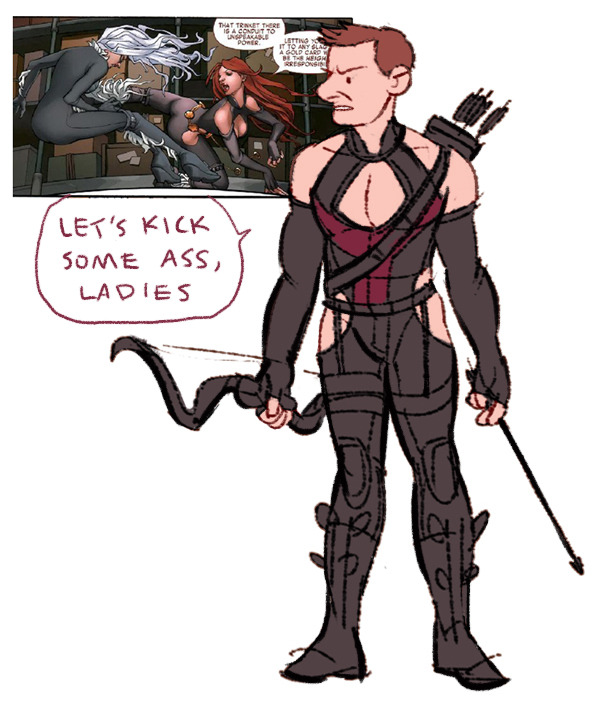
There's been a lot of talk in the last couple of years about the way women are drawn in the comics, with a particular emphasis on physically-impossible poses women contort themselves into so they can show off their breasts and their butts at the same time. Who knew Wonder Woman was an invertebrate? It's the only possible explanation for this:


This little collection of six comic books are a good demonstration of greater variety than that, which suggests that artists aren't just following convention when they draw mostly-naked women with painted-on costumes, but making a choice. David Aja shows that different choices are possible. Pulido's got more stylized cartoonish style, which shows not only in characters' features and body shapes but in how they move and interact as well, as you can see in the body language in this panel:


But I'd argue that a cartoonier style doesn't require sexing things up. I find myself wishing artists were thinking about these things more, and making better choices.

The upshot of all of this is that I've now  read a sum total of six comic books published in the last decade, but I already have a favorite artist. David Aja, whose Clint Barton just can't ever catch a break:


Coincidentally, there's a fan campaign from a couple of years ago that sought to point out the ridiculousness of the way women are drawn in comic: The Hawkeye Initiative.  Artists recreate comics panels with Hawkeye in place of the half-naked buxom warrior women. It's fun to browse.