Showing posts with label books. Show all posts

Wednesday, May 13, 2015

Rainbow Rowell: An Appreciation

This is not a book review. I don't want to spend any time talking about the strengths and weaknesses of Rainbow Rowell's writing; though no writer is perfect, right now I don't care about Rowell's imperfections.

What I care about, and what I want you to care about, are her prodigious and unique strengths. The reasons why I love her books, why they stayed with me for months after I read them the first time, and why I was happy to spend half a day re-reading two of them, Fangirl and Eleanor & Park, so they'd be fresh in my mind as I wrote this. Why I could totally sit down sometime in the next two weeks and read them again to get my money's worth before I have to return them to the library.

I give Rainbow Rowell the full tape-flag treatment.

Without further ado, and in no particular order, some things I love about Rainbow Rowell and her books.

1. She goes full Nebraska.

Rowell lives in Nebraska, and so do her characters. Even in her novel Landline, in which the main characters live in the Los Angeles area, they're from Nebraska. Her characters grow up in Omaha or Lincoln, or in tiny western towns, and they go to college at the University of Nebraska, where they have a tendency to fall in love.

I'm not from Nebraska, but it feels like home to me when I read Rowell's books. I have lived most of my adult life just down the road from a land-grant university; going about our daily business, we routinely drive past vast fields subdivided into what I think are grad student turf-grass research plots; paddocks holding flocks of sheep and herds of cows; and the Poultry Teaching and Research Center, which always—always—inspires a tired joke about just what they're teaching the chickens in there. When I was young, and "what are you studying?" was the kind of question you asked new people, the answers included Forestry; Fisheries; and, always my favorite, Swine-Herd Management.

Like Michigan, Nebraska is at least two states: the cities, and the Everything Else. Awhile ago, I was chatting on-line with a friend who lives in the Boston area, and he was asking me what it was like where I live. I described our little suburb. He asked what was to the south. I said, "Farms and small towns." To the east? "Farms and small towns." To the north? "Farms and small towns." To the west? "Land-grant university, declining industrial city...then farms and small towns, all the way to Lake Michigan."

Rowell pulls her characters from both Nebraskas. In Fangirl, Levi is a Range Management major from a ranch in western Nebraska, and Cather is a writer from an Omaha family where word-play is a source of pleasure and connection. Cath finds it hard to accept what she sees as Levi's limitations, cringing when he sends her a text that mis-uses "your." Levi gets mad at Cath when he thinks she's squandering an academic opportunity because it comes so easily to her.

Why this matters is because Rowell gets that people who fall in love are not necessarily alike. Levi and Cath don't fall for each other because they have so much in common; they do it through kindness and compassion, which comes easier for Levi than for Cath. It also matters, this whole Nebraska thing, because Rowell gets that those of us in the vast middle of the country are living important stories and meaningful lives. She doesn't move her kids to New York or Chicago to give them adventures; she lets them live their adventures at home.

2. Rowell gets that young people hurt each other through ignorance and carelessness more often than through malice.

In Fangirl, Levi says to Cath, "I'm not really a book person." She replies, "That's the most idiotic thing I've ever heard you say." Forty or so pages later, Levi is anxious because he hasn't been able to read the book for an English test and the friend who is supposed to help him study, Cath's roommate Reagan, has forgotten. Cath cannot fathom the idea that Levi is unable to read a book . "I've never finished a book," he tells her. "I can read. I just can't read books."

"So pretend it's a really long street sign and muddle through it," she tells him, and he replies, "Jesus. What have I ever done to make you be so mean to me?"

Cather's not being mean on purpose; she loves books so much and finds the written word so congenial that she simply can't imagine it being different for Levi. Not to read books is a moral failing, and so is studying with a friend in the hope of being able to pass a test in Young Adult Literature without actually reading the book.

A few pages later, she apologizes to him. "I'm sorry," she says. "I didn't realize we were having a serious conversation until we were."

This is how it really happens, in my experience. As young people step out into the world, they encounter all kinds of things they've never had to be aware of before. In Cath's case, it's Levi's learning disability. In Eleanor & Park, Park grows up in a comfortable middle-class home where the furniture matches the curtains, and he doesn't understand at first that he might actually put Eleanor in danger if he shows up at her house and Eleanor's step-father finds out about him, that she resists letting him write down his phone number for her because she has to protect everything that matters to her from Richie and can't risk Richie seeing the number and wondering about it. Later, Park can't deny it when Eleanor says that she embarrasses him. He loves her, but when he sees her through the eyes of other kids at school, or his mother, or even himself when he first met her, it bothers him. He is ashamed of this, but can't just make it go away. He struggles with it.

3. Rowell writes girls who are strong and awesome even when they're flawed.

Rainbow Rowell has a talent for loving her characters, even the not very likable ones, and she recognizes that people can be awesome and messed up at the same time. I especially like Cath, the protagonist of Fangirl, as an example of this. Cath has anxiety severe enough that she begins her freshman year of college with a plan to live on peanut butter and protein bars for as long as she can, so as to avoid the terrors of the dorm cafeteria. She has an identical twin, Wren, whom she has decided is the pretty one, and Wren's decision to room apart at college has left Cath feeling rejected and unmoored.

It's not hard to see why people like Cath: she's funny, smart, and cuter than she thinks she is, though, to be fair, her roommate Reagan ultimately befriends her from pity. "I feel sorry for you, and I'm going to be your friend," Reagan says. Cath replies, "I don't want to be your friend. I like that we're not friends." Reagan says, "Me, too. I'm sorry you ruined it by being so pathetic."

More important to me, though, is that Cath is a freaking expert at setting boundaries. Early in the book, she comes home to find Levi waiting outside her door. She's met him once, when he was in the room with Reagan the day she arrived at school, and he assumes that Cath will let him in to wait for Reagan to get home. She doesn't. She tells him, "I can't just let strange guys into my room. I don't even know your name."

She just wants to be alone, but she's also resistant to the kind of social pressure that would lead many, if not most, of us, to let him in, even if it made her uncomfortable.

Her golden moment comes later in the book though, after their first kiss. A few days after she and Levi kiss for the first time, she sees him kissing someone else at a party. They eventually have this conversation about it:
"Cath..." he said. "I'm so sorry. 
She wasn't quite sure what he was apologizing for. He looked up at her, from the top of his eyes, looking genuinely sorry—and sorry for her. "It was just a kiss," he said, pleating his forehead. 
"Which one?" she asked. 
Levi pushed his hands to the back of his head, and his bangs fell loose. "Both of them." 
Cath took a deep, shaky breath and let it break out through her nose. "Right," she said. "That is, um... good information to have." 
"I didn't think—" 
"Levi." She cut him off and looked him straight in the eye, trying to look stern despite her tears. "I can't thank you enough for bringing me [to the hospital]. But I couldn't mean this more: I'd like it if you left now. I don't just kiss people. Kisses aren't...just with me. That's why I've been avoiding you. That's why I'd like to avoid you now."
This is awesome. Her insecurity about her attractiveness, and a desire to save face, could easily lead her to pretend that kissing him was casual for her as well, or to decide that even if he was less invested than she was, she should keep seeing him anyway. She doesn't do that. She tells him the truth, and she gives him the boot.

4. Rowell's other characters are also complicated

With the exception of Eleanor's stepfather Richie, who is a straight-up bad guy, Rowell writes characters who have complicated strengths and weaknesses, who are both compassionate and prejudiced, whose love is not always an easy gift to receive. I especially like Park's parents, Mindy and Jamie. Late in the book, Park reflects that he has never been sure his father loves him; Park is slender, punk, a little effeminate. Even after he starts dating Eleanor, he still wonders if he might be gay. On the other hand, he thinks, it's obvious his parents love each other.

The relationship between Mindy and Jamie is a real strength of this novel. Mindy, who came to the US from Korea as a young woman to marry Jamie, values order and niceness to such a degree that she finds Eleanor, who is fat, dresses strangely, has a sarcastic sense of humor, and for a good half of the book doesn't even own a toothbrush, almost unbearable. Jamie, on the other hand, likes a certain kind of manliness; to be a pussy is just about the worst thing he can think of. Park, sadly, is kind of a pussy.

Mindy and Jamie each keep the family on-track by pushing each other aside and taking over when they have to. When Mindy starts ranting about Eleanor, saying she is not welcome to come to the house again, Jamie shoos Park outside, and comes out a bit later to say that Mindy has re-thought things and Eleanor is welcome. When Park discovers he likes wearing eyeliner, and his father is angry and disgusted with him, trying to force him to wash it off before school, Mindy vetoes him. "You tell me Park all grown up now, almost man, make own decisions. So let him make own decisions. Let him go."

It doesn't fix things; Jamie doesn't speak to Park again for weeks. But it lets Park be himself and it prevents Jamie from breaking things irrevocably. Jamie and Mindy do this for each other again and again.

5. Rowell accepts that she can't save her characters from unsolvable problems.

This is true in Fangirl, in which Cath and Wren come from a family touched by mental illness and abandonment in ways that can't be fixed with an epiphany on page 247. It's true most heart-rendingly when Eleanor and her four younger siblings talk about the possibility of Eleanor leaving home.
"I can't take you with me," she said, "if that's what you're thinking." 
"Why not?" Ben said. "We'll just hang out with the other kids." 
"There are no other kids," Eleanor said. "It's not like that." 
"You don't care about us," Maisie said. 
"I do care," Eleanor hissed. "I just can't...help you."
6. Rowell wrote a fat girl. An actual fat girl. Who fell in love and was loved without needing a makeover.

And Rowell insists, when people ask, that yes, Eleanor is actually fat. I'll let Rowell speak for herself on the subject.

Edited to add: Another nice touch is that Park's attraction to Eleanor is actively due, in part, to his appreciation of her specific body. The scene where he sees her in her too-tight gym uniform at school and is overwhelmed by this glimpse of her body, and by the possibilities of the long zipper down the front of the uniform, is so nicely done. This is to say, Park isn't attracted to Eleanor despite her weight. Her body, exactly as it is, is beautiful and exciting to him.

7. Rowell is a master of the slow build.

Rainbow Rowell is especially talented at describing how love and attraction grow. She's not in any hurry. Nobody is struck dumb at first sight by the beauty of their beloved; nobody falls head-over-heels in a weekend. They might like each other, but they have to get to know each other. In Eleanor and Park's case, Park is horrified by Eleanor when she gets on the school bus for the first time, and isn't sure he has enough social capital to survive letting her share his seat. They warm up to each other slowly. Very slowly. Their relationship begins with him realizing that Eleanor is reading his comic books over his shoulder on their bus rides, and him deciding to read a bit more slowly to be sure she can keep up. It's the very definition of tentative. By the time her characters fall in love, you really get why they've fallen in love.

8. Rowell knows how to write about sexual attraction.

Part of the slow build in Eleanor & Park is the two of them discovering their attraction to each other. Rowell writes this beautifully. The book alternates between Park and Eleanor's points of view, and when their attraction comes to a head, Rowell gives us a masterful little tennis volley between the two of them:

Eleanor
[Park] laughed again. His face completely changed when he laughed. He didn't have dimples, exactly, the the sides of his face folded in on themselves, and his eyes almost disappeared. 
"Just wait," he said.
Park 
That morning, in English, Park noticed that Eleanor's hair came to a soft red point on the back of her neck. 
Eleanor 
That afternoon, in history, Eleanor noticed that Park chewed on his pencil when he was thinking. And that the girl sitting behind him—what's her name, Kim, with the giant breasts and the orange Esprit bag—obviously had a crush on him.
And later, there is another exchange of quick observations like these:

Eleanor
Park was just her height, but he seemed taller.
Park
Eleanor's eyelashes were the same color as her freckles. 
9. Rowell's girls are interested in sex.

I can't tell you how many young adult novels I've read in which sexual activity takes place in a kind of fuzzy place where a girl doesn't quite understand what's happening and isn't clear about her own volition or desire to be there. Have I ever read a young adult novel, before Rowell, in which girls look at boys with hunger, and crave touch? If I have, I don't remember it.

Thank God for Rainbow Rowell. Her girls are sexually interested in the boys they like, and whatever hesitation her characters have about sex is not about virginity or purity or sluttiness or reputation. Eleanor's attraction to Park is so strong and earthy that she is repeatedly taken with the desire to bite him. "You're so pretty, and so good," she tells him on the phone one night. "And you make me feel like a cannibal." Another time she thinks to herself, "Don't bite his face. It's disturbing and needy and never happens in situation comedies or movies that end with big kisses."

Here is one of my favorite passages, from early on, when they're completely overwhelmed because they're holding hands for the first time:

Eleanor
Disintegrated. 
Like something had gone wrong beaming her onto the Starship Enterprise. 
If you've ever wondered what that feels like, it's a lot like melting—but more violent. 
Even in a million different pieces, Eleanor could still feel Park holding her hand. Could still feel his thumb exploring her palm. She sat completely still because she didn't have any other option. She tried to remember what kind of animals paralyzed their prey before they ate them... 
Maybe Park had paralzyed her with his ninja magic, his Vulcan handhold, and now he was going to eat her. 
That would be awesome.
When she sees Park in eyeliner for the first time, in the salon his mother runs out of their garage, Eleanor loves how it makes him look. The next day, when she sees him wearing it in the wild for the first time, she's overwhelmed:
When Eleanor got on the bus, she was in a good mood. "You're here! I thought maybe you were sick when you weren't at my corner." He looked up at her. She looked surprised, then sat down quietly and looked at her hands. 
"Do I look like one of the Solid Gold dancers?" he asked finally, when he couldn't take any more quiet. 
"No," she said, sidelong glancing, "you look..." 
"Unsettling?" he asked. 
She laughed and nodded. 
"Unsettling, how?" he asked her.

She kissed him with tongue. On the bus.
Edited to add: the girls in Rowell's books make different decisions about sexual activity, and none of them are presented as wrong, or bad, or damaging. In Fangirl, for instance, Cath is inexperienced, but her sister Wren has had sex with at least one high school boyfriend, and at least one college boyfriend. Reagan and Levi slept together while dating in high school; part of why they broke up was that Reagan, in her own words, kept cheating on Levi. But now, a couple of years later, they're good friends, and Reagan routinely dates multiple boys. This is refreshing.

 9. I don't think Rainbow Rowell is afraid of the queer reading. God knows I'm not.

Back in January, when I read Eleanor & Park for the first time, I kind of live-blogged it on Facebook. Here's what I wrote:
Today's book is Eleanor & Park, which is very good and chock-full of feelings in a way that is going to leave me pretty well wrecked, I can tell already. 
Have there ever before been two protagonists before who fell in love while arguing over whether the X-men comics are sexist or not? Probably not. It's awesome. 
I'm really hard on books. Books that get ecstatic reviews seem to me like they suck. Books I like are often nonetheless part-sucky. So when I'm reading a book I think is amazing it's a really intense and kind of overwhelming experience. There's good evidence Eleanor & Park is going to break my heart. I hope David and the Tiny Tornado bought ice cream and/or chocolate at the grocery store. 
Eleanor & Park is very close in tone, plot, and story beats to this really terrific Steve/Bucky high school AU fanfic I read awhile ago, with Eleanor as Bucky and Park as Steve. A little weird to be thinking, "I haven't read anything as good as this award-winning national bestseller since that one fanfic." But there you have it.
I think Rainbow Rowell knows about uncanny proto-queer magnetism. Eleanor and Park are totally playing out the story of a boy and girl who are into each other in part because of this unspoken queerness they both have. Especially given that it's set in the 80s. The music, the comics, the faggy boyfriend... So familiar. 
Park's beautician mom has just put eyeliner on Park, and Eleanor can't look away from how pretty it makes him. One of the things this book is about is how a relationship between a boy and a girl can still be queer. It's awesome. 
Park wears eyeliner to school the next day. Eleanor loves it. Reviews I've seen call this a story of "misfits" in love. Misfits seems to me like code for a word they either don't know because they don't see what I see, or that they're uncomfortable using. 
"Surely," I think, "I can't be the first person to notice Eleanor & Park is a queer romance." So I google and find lots of people explaining very earnestly that Park is totally not gay and one of the great things about the book is how stereotype-busting the heterosexual leads are. I don't know these kids' sexual orientations. But whatever they are, "heterosexual" does not begin to cover it. 
Heart only semi-broken. I think my head-canon that these kids are some kind of queer means they can't really figure themselves out until they're apart and away from Omaha. 
Because David is a lovely guy, he patiently listened to me tell him all about Eleanor & Park, and how I imagine the story might go on. Eleanor's in Minneapolis by the end. Meaning she is in one of the many midwestern towns that somehow became hotbeds of amazing lesbian culture from the 70s through the 90s: the twin cities, Iowa City, even right here in Lansing. Eventually she must find her way to Amazon Bookstore, right? How could she not? Maybe she forges a bi identity; maybe she can't hold out against the pressure to just be a dyke for the next decade or so. Park wants her to come back to Omaha, and she misses him, but she's smart and a realist: she knows she's better off where she is. Park doesn't do too bad in Omaha. He's already in touch with what Eleanor called an Omaha she never imagined: the punk record shop, the coffeeshops, the part of town where neither of them seem as out of place as they do at the high school. He goes to college, maybe at Nebraska or one of the lesser Ivies. He's on his way to class one day and there's a flyer for the campus gay & lesbian group masking-taped to the door of the building. He doesn't want to stand there to write down the info, so he pulls the flyer down and takes it with him, and he goes to the next meeting, and there you have it. He graduates, heads to grad school in New York or San Francisco. It's not even special. This is what we all did back in the 80s. The Midwestern Queer Kids version of the Game of Life. 
(If you don't care for my queer reading of the book, that's OK but I don't need to hear about it. I had some things to say on the subject of queer readings recently. And I am 100% sure that Rainbow Rowell would approve of my notional explicitly queer fan mix of her wonderful novel. As Cath says about Simon and Baz, "When I write them, they're gay.")

Thursday, March 26, 2015

Flyboy Action Figure Comes With Gas Mask: A Book People Should Read

A couple of months ago, my friend dan recommended Flyboy Action Figure Comes with Gas Mask, a book I'd never heard of by some Canadian guy I'd never heard of. I'm glad he did, I'm glad I read it, and I'm glad to upgrade author Jim Munroe to the short list of Canadian Guys I Have Heard Of.

Authentic Canadian Cover for Purists


Cover for the American Release


Flyboy is about Ryan, a Toronto college student whose secret power is that he can turn into a fly. He meets Cassandra: she's a waitress, a single mom, and the former singer for a famous-in-certain-circles punk band. She can make things disappear.

It doesn't take much reflection to figure out that Ryan's superpower kind of sucks. Flies are annoying, but powerless; they can be fairly easily swatted, or trapped, purposely or accidentally. This is underscored from the first scene in the book, when one of Ryan's roommates smashes a fly on Ryan's bedroom wall, leaving behind a bloody smear that never gets cleaned up. To further complicate things, Ryan returns to human form buck-ass naked, and, if he's been a fly for very long at all, covered from head to foot in a layer of viscous green slime.

On the other hand, it takes Ryan and Cassandra awhile to figure out just how awesomely powerful she is. They join together as Superheroes for Social Justice, and lend their powers to the social and political action they're already part of, a community of young activists who deface offensive billboards and attend hastily-organized political meetings in the damp basement where they also attend terrible poetry readings when they're not busy organizing this year's Take Back the Night March.

As someone who was part of a community just like this back in the 90s, when the book takes place, I found Ryan and Cassandra's community very familiar and comfortable, and would hand it to my kids to read with the introduction, "Just imagine that everyone in this book is a lesbian, and, except for the superpowers thing, this is exactly what my life was like in my 20s."

Cassandra and Ryan don't want to hurt anyone; their goal is something more like civil disobedience, and shaping creative punishments to fit the crimes of the powerful. For instance, angry that the police did not respond to the organizers' request that officers assigned to the TBTN march be female and unarmed, they march the route, Cassandra disappearing each officer's gun as they come into sight. They then introduce themselves in their thrift-store superhero costumes and make a statement to the press

The news coverage, when it comes, focuses on Cassandra's looks, and they punish the newspaper's sexism by driving around late at night, disappearing newspaper boxes. Ryan drives, and after awhile Cassandra slips into inattention, looking up quickly and doing her thing when Ryan tells her they've reached the next box.

This inattention is how she accidentally disappears a mailbox.

R & C are so conscientious that the disappearance of the mailbox bothers them on its own merits: "What if there were personal letters in there?" one of them says. But from there, the "what-ifs" pile up. What if instead of a mailbox, there had been a person there? Cassandra already knows she can disappear people; her power manifested when she accidentally disappeared an uncle who was trying to molest her when she was six. She and Ryan start speculating about the limits of her power. "Could you disappear the sun?" Ryan wonders. Cass doesn't want to think about it.

The superhero storyline is fun, and thoughtfully played out: Ryan's relatively weak power makes him, inevitably, the sidekick, and it's a lovely thing when a straight white guy ends up the sidekick to a bisexual woman. As a fly, he can observe (he helpfully retains his brain and ability to read), but his power to act is very limited, and there is a tense scene in the book when he is witnessing something terrible and can neither escape from having to see it, nor stop it. Cassandra's power, on the other hand, is almost infinite. She is ultimately faced with knowing she can stop a terrible thing, but only by doing a terrible thing. Can she do it? Can she live with herself if she does?

I don't love this book for the superhero stuff, though. I love it for the way that Ryan and his male friends are trying to navigate their relationships and their place in the community they've chosen. They are white guys trying to be decent white guys, and their efforts are touching. They want to be supportive of each other but aren't sure where the lines are; they want to be decent to the women in their lives, but aren't sure they know how. Ryan's friend Jack gives him The Female Eunuch to read at one point, and I admit that touched my crusty old battle-hardened feminist heart.

I love a moment, too, when Ryan, just getting to know Cass, is so overwhelmed by her vocabulary and intelligence that he has to curl up in a ball for a minute. A few pages back, he was admiring her looks, but it's her brain that renders him speechless. Ryan and Cass meet with one of her exes, who is territorial and hostile with Ryan. Later, Ryan wonders out loud what it means that he didn't feel threatened by her behavior, whereas he thinks he would have if she'd been a man.

Cass says, "It means you don't see a woman as a realistic competitor for a sexual partner. It means you're a little bit sexist, and a little bit homophobic."

Ryan thinks, "Ah. Good to know." (paraphrased from memory here)

I have three sons, and I would give them this book to read because they would be into the humor of it, and the superhero stuff. But I would really like them to see, too, the way Jim Monroe portrays male friendship, female friendship, community, and romantic relationships. 

I did roll my eyes at Cass's Perfect Fiction Baby. As is so often the case in books and movies, Cass is a single mom who rarely suffers the real challenges of single motherhood. She says, "Just let me put the kid to bed and I'll be right back," and emerges from the bedroom a peaceful five minutes later. When adult conversations need to happen, the child entertains herself endlessly with toy cars; when an adult conversation has to happen in a restaurant, the child interrupts only once, and then only briefly, despite having nothing to entertain herself with but a napkin and a pair of chopsticks. Cass's apartment comes equipped with a Child-Loving Older Woman Who Lives Alone In The Apartment Downstairs, and who is so delighted to watch Cass's child that neither Cass's job, nor her social life, nor her political activism, have to suffer; Cass can set her own schedule and be relied upon to keep it, while the grandmotherly neighbor picks up the extensive slack.

I get that these kind of fictional children are an expediency that allows writers to include children in characters' lives while telling stories that are not primarily about parenthood and children. Along with everyone's bathroom habits, most of the meals they eat, the haircuts they never mention getting unless it's central to the plot, and the bills they must be sitting down to pay at least sometimes, most childrearing challenges take place off-stage so as not to bog the story down. I'm still in a stage of parenting, though, where I'm very aware of the enormous disconnect between these fictional children and the real thing, and so I can be forgiven an eye-roll or two.

You can buy copies of the book at Jim Munroe's website, No Media Kings, and I recommend you do. Munroe offers a pay-what-you-can ebook option as well. dan also recommended Munroe's book Angry Young Spaceman, if I recall correctly, and I look forward to reading that next.

Thursday, March 12, 2015

Book Report: Queers Dig Time Lords

Sometimes I can't let go of a book until I've written about it. If it gives me ideas, I have to work them out a bit before I feel done. I have a few books that have been languishing on my table because I haven't had the time to do this. I tried just putting them back into the library bag anyway, and they made little sad noises, and the knowledge that I had unfinished book business hurt my brain. I'm going to try to write about them, but quickly, because I have other stuff to do.

First up: An anthology called Queers Dig Time Lords, a "celebration of Dr. Who by the LGBT fans who love it." Like all anthologies, this one includes too much and is wildly uneven. Its 27 essays include far too many that are essentially autobiographical anecdotes about the role Dr. Who played in lives of young queer people. The first few are interesting and invoke at least some shared memories; probably every queer kid who was exposed to books and TV has this same relationship, if not to Dr. Who, then to some other work that aroused interest and hinted at possibilities. Ask any lesbian of about 50 about Harriet the Spy, Jo on Facts of Life, or the wonder that was Cagney & Lacey, for instance.

The trouble with these familiar stories, of course, is that they're familiar. I found that the fun of reading about a shared experience shifted quickly into impatience. It didn't take me long to start skimming any essay that started with a quick precis of the author's childhood circumstances, not willing to invest in a full reading unless I saw some hint that this one was managing to say something new, or different, or unusually insightful.

The strongest essays in the book are the ones that deal less with an individual's relationship to the show, and more with questions of what it means to perform a queer reading, and what it means for a show to allow—or, sometimes, to disallow—that queer reading.

It's been my experience that this idea of queer people actively engaging with creative works in order to situate ourselves and our experiences within them, and to use them in our formation of self, is one that straight people have a hard time grasping. One time on Facebook, I mentioned the Holy Trinity of the pre-coming-out teenage lesbian of the late 70s and early 80s: Jodie Foster in anything, the aforementioned Jo, and Buddy on the show Family. A straight friend of about my age commented, "Huh. I don't remember that plotline." I wanted to shake her and say, "Don't you get it? It wasn't a plotline. Nobody gave us plotlines. They gave us girls who were just the least bit less girly than all the other girls, just a little bit tougher, who had something of a way about them that spoke to something in us we hadn't so much as named yet. We turned them into role models and objects of affection."

Yes:


Hell, yes:


Oh, hell yes.


Two out of three of these actresses are out lesbians now, by the way.

It's been my experience that heterosexual people not only struggle to understand how very important the possibility of queer readings are to us, but that they can be actively hostile to the possibility. Last year, in a MetaFilter conversation about this essay on Harriet the Spy, it took only until the third comment for people to start denying the possibility of a queer reading of Harriet or the Boy with the Purple Socks,  or suggesting that claiming a queer reading was akin to thinking Bert & Ernie on Sesame Street are gay. As a queer person, it's hard to hear people denying something that nobody is claiming as a fact. Nobody says, I don't think, that Harriet M. Welsch or Janie is a lesbian. What so many of us experienced in the late 60s and early 70s, as 11-year-old proto-queers ourselves, was that Harriet, changing out of her school clothes and into jeans and ratty sneakers, and spending her afternoons going to places she wasn't supposed to be, called to us. And what we understand now is that she called to that part of us that was queer.

I remember loving the illustrations in that book. When I was in early elementary school, girls were still being forced to wear skirts to school, though by the time I was in late elementary school this was no longer true. I have friends who remember forced skirt-wearing as traumatic, as a denial of their identify and self-expression (myself, I liked skirts except for the need to hold them up when hanging upside down on the monkey bars). But then there was Harriet, who came into the world in 1964—just one year before I arrived—looking like this:


I didn't know which I wanted more: to be her, or to be near her.

The thing straight people seem to have trouble understanding is that a queer reading of a work doesn't foreclose any other readings. If you loved Harriet the Spy because it included a girl who was a scientist or a sweet, nurturing boy who cooked or, like a whole generation of writers of assorted genders and sexual orientations, because you really understood what was up with Harriet and that notebook and her need to observe and to write down what she saw, that's fine and good. It doesn't take anything away from you for little pre-pubescent lesbians to grab onto Harriet and hold on tight. But for those little lesbians, it can mean everything to have a hint, here and there, that who they are and what they want exists in the world. Harriet the Spy was one of those hints.

Louise Fitzhugh, by the way? A lesbian. A butch lesbian, my hand to god. And she wrote a book, Amelia, that was about two girls falling in love. She couldn't get it published and the manuscript is lost. But it existed. She wrote it. I'm glad to know it.


My point is that we had so little. And so many young people coming up today still have less than you might think in terms of access to stories, role models, images of the erotic that speak to them. Queer readings allow us to take that little and make much of it. In a good essay in Queers Dig Time Lords, "Bi, Bye," Tanya Huff writes:
There are complaints from the, shall we say, straighter parts of the world, that if you're queer, you're always trying to find the queer subtext. To that I say, 'Well, duh.' Everyone wants to find the 'me-shaped door' that lets them into the story. Unlike those straighter parts of the world, we have to search for it because if it's there at all, it's usually buried deeper than the pea in The Princess and the Pea. (p. 87)
In addition to Hoff's essay, which focuses on Jack Harkness, I very much enjoyed Amal El-Mohtar's essay "Sub Texts: The Doctor and the Master's First and Lasts," which, among other things, explores the way that the Stephen Moffatt Dr. Who closes off expansive queer readings of subtext by providing explicit, but limited, queer text. She writes:
...when you're a queer woman of color...consuming film and telelvision and books is often like being handed beautiful, elaborately sculpted meals with bits of cockroach poking antennae and carapace out of the sauces and souffles. You try to eat around the bugs...but you can't quite get away from the fact that they've flavored the dish and will probably make you sick. But you have to eat, or go hungry.... 
If consuming media was like picking bugs out of impressively prepared food, subtext was like a waiter slipping me some ingredients on the sly with a knowing wink and suggesting I make something myself. 
In many ways, it was even more freeing to me than explicit representations of queer desire, because it allowed, even depended, on my participation and imagination. By drawing me into a world of potentials which I could have a part in determining, it gave me power. (pp. 63-64)
For El-Mohtar, there is something to be preferred about the old Dr. Who, when he was portrayed as a more-or-less asexual being; no story about his loves or his sex life could be denied, because none were being told. Everything was still possible. "Since Stephen Moffat became showrunner," she writes, "the reboot has favored token explicitness over the vastness of subtextual potential, especially where men are concerned.... To take Series Six as a case in point, Canton Delaware III has a black male lover whom we never see, and the existence of whom is delivered as a punchline; we get a gay male couple...who have no names besides 'the fat one' and 'the thin one,' also presented as a wry joke." (p. 65)

She's naming an important phenomenon here: that, on the one hand (and not just in Dr. Who), it's exciting, almost dizzying to have so many explicitly named gay and lesbian characters show up in our media. On the other hand, most of the time explicit naming is all we get. El-Mohtar writes, "Ultimately, I long to be shown as well as told about queer relationships. So often we only get one or the other—shown same-sex desire that dare not speak its name, or told about same-sex desire that dare not show its face.... Russell T. Davies in Torchwood has given us a lot of queer sex without meaningful queer relationships; Steven Moffat has given us queer characters in relationships who never so much as hold hands on screen." It's a complicated trade-off between having almost no representation at all, but the freedom to imagine what isn't named, or having representation that falls short of what is needed and simultaneously, by telling a story, forecloses some of possibilities of the collaborative queer audience.

Brit Mandelo takes the idea of collaboration between audience and work even further in "Torchwood, Camp, and Queer Subjectivity." Her essay opens, "the first thing I saw of Torchwood was a clip excerpted from the opening episode of the second season." If you are a fan you know immediately which scene she's talking about:


If you don't care to learn by clicking, I'll tell you that this is the scene where Captain Jack Harkness is reunited with Captain John Hart, and they demolish a bar in a passionate eruption of kissing, fighting, and drinking. Mandelo says it's camp. And not only that, but so is everything else in the show. And this is important for queer folk because we get camp. She says, "The interrelationship of camp and gay culture hearkens back more than just a few decades, and...some of the first stuff we may have seen that looked a little bit like us came in the form of campy, over-the-top comedies." (p. 157)

It's hard to define camp for folks who aren't familiar with it, and I think it's impossible to ever define it briefly, but Mandelo does a pretty good job:
...the sense of camp in Torchwood is part of its distinctly queer ethos, part of what makes it speak directly and understandably to me. If we take camp according to the terms I've been applying to it throughout—exaggerated, theatrical, parodic, ironically nostalgic, over-the-top in reference and performance alike—it's pretty obvious where Torchwood fits on the continuum; John Barrowman's performance of Captain Jack Harkness alone dings every point on the checklist. (p. 158)
This is a nifty point, that queerness is not just about content but about style. ("Of course it is, dear," my inner gay man says, saluting me with a martini glass and sardonically raising one perfect eyebrow.)

I thought, when I started this, that I was going to crank out a quick three paragraphs so I could finally return the damn book to the library. That didn't happen, obviously. Probably because this question of queer readings is more important than you might give it credit for. It's not just a game. It's a survival strategy.

Friday, December 12, 2014

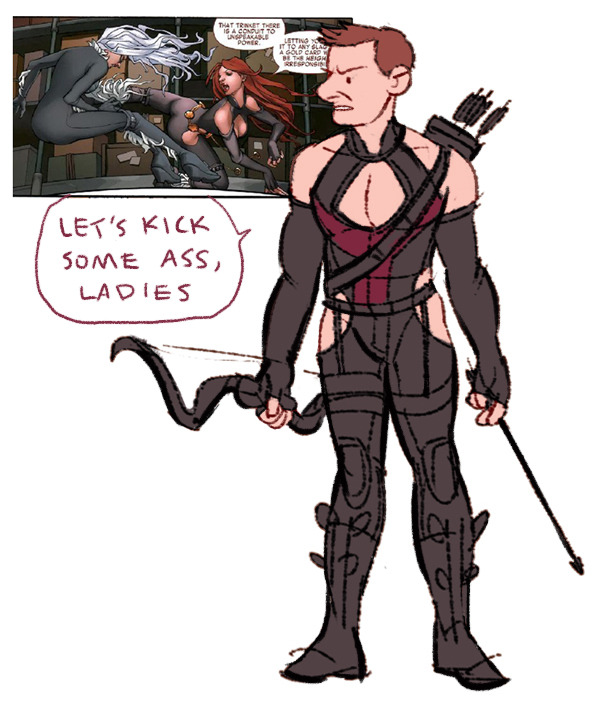
I'm Not Bad, I'm Just Drawn That Way: Hawkeye In the Comics

I used to read comics regularly back in the 80s, primarily The Uncanny X-Men. I was eventually driven out of the fandom by tie-ins with other series, like Spider-man or Iron Man, which required you to buy other comics in order to keep up with your story. When it got to the point that I was having to buy 3-5 comics a month in order to follow the X-Men (and yes, I had to, because I am a completist with an OCD diagnosis) my resentment and limited college-student budget overcame my affection for the comics, and I quit.

I'm amused to see that the comics that were driving me into the poor house cost 65 cents each:


My partner Raider was a serious collector in his childhood and youth; our basement still contains longbox upon longbox of DC Universe comics, each individually stored in a protective plastic sleeve.

So, when the Marvel Cinematic Universe became a thing, we were right there. Not only are Raider and I long-time sci-fi fans with fond memories of our comics-reading days, but we have three kids who love that stuff, too. The opening of a Marvel movie is a family event for us, one that Raider and I celebrate with more sincere enthusiasm than any other, including Christmas and Easter.

Because I always want more of a good thing, it was inevitable that I would discover fanfiction, and then, eventually, looking for something else we could share as a family, would look into the comics. So a week or two ago, I brought home Hawkeye: My Life as a Weapon from the library. 


This is a trade paperback collection of issues 1-5 of the recent Hawkeye standalone comics, as well as one issue of Young Avengers Present which features Hawkeye. Here's the intro:

Clint Barton, aka Hawkeye, became the greatest sharpshooter known to man. He then joined the Avengers. This is what he does when he's not being an Avenger. That's all you need to know.
All six issues collected in My Life as a Weapon were written by Matt Fraction, and I like Fraction's take on the character. Clint's good-hearted but impulsive; he never thinks things through, and it lands him in trouble. He's a bit hapless. He owns a crappy apartment building in Brooklyn because the old landlords were raising rents and planning to evict his neighbors, so he bought it. He has a one-eyed pizza-eating dog named Lucky because he can't stop helping; when he sees Lucky hit by a car, he takes him to the vet, and then home.

One story line starts with him deciding it's time to organize his trick arrows; he's got them all spread out in his living room when he discovers he doesn't have any tape for labeling them. He heads out to buy tape, ends up impulsively buying a car then impulsively sleeping with the women who sold him the car, who of course ends up kidnapped because this is a comic book. Ultimately, he and Kate Bishop end up fighting a battle with his unlabeled trick arrows, so they don't know what any given arrow will do until they shoot it ("Oh, hey, explosion!").


I like this Clint, though I understand it's enough of a departure from previous versions of the characters that some long-time fans have been unhappy with it.

But that's not what I wanted to talk about.

I want to talk about how the characters are drawn. The first three comics in this collection are drawn by an artist named David Aja; the next two by Javier Pulido; and the Young Avengers Presents issue is drawn by Alan Davis.

I was really liking Aja's way of drawing the characters. His Clint is a pretty regular-looking guy, not much broader in the shoulders than in the hips. Kate Bishop is a regular-ish teenage girl in both her dress and her build. They both spend most of their time in jeans and t-shirts. We get a bit of Naked Clint because he's the kind of guy who finds himself unexpectedly unclothed and without transportation, but Aja gives us absolutely no Kate cleavage or butt shots. Aja doesn't seem interested in drawing characters with the kinds of exaggerated physical features you tend to associate with comics. So you get characters who look more-or-less like people. A very narrow selection of people, sure, but people nonetheless:


I hadn't been paying attention to the artist, until I got into Issue 4 and things looked different. Apparently Clint's been really hitting the gym because his shoulders are now way bigger than his hips. If the David Aja Clint is a guy you'd see on the street and think, "nice-looking guy," Javier Pulido's Clint is going to make you think, "Whoa, that dude is built!"


Meanwhile, poor Kate Bishop gets a really bad case of Cartoon Girl Face, complete with Jessica Rabbit lips and ridiculous eyebrows:


And this is what she now looks like in a t-shirt and jeans:


Everything is just that bit exaggerated: big eyes and lips, tiny waist, breasts! and curvy hips on Kate, and Weightlifter Triangle Torso on Clint. Kate is also a lot shorter than Clint in Pulido's world, whereas you can see that Aja drew them within a few inches of each other. He's bigger and she's smaller, because the things that supposedly make a man a man and a woman a woman are being emphasized here.

Meanwhile, the less said about the action figures and Barbie dolls who populate Young Avengers Presents, the better:


There's been a lot of talk in the last couple of years about the way women are drawn in the comics, with a particular emphasis on physically-impossible poses women contort themselves into so they can show off their breasts and their butts at the same time. Who knew Wonder Woman was an invertebrate? It's the only possible explanation for this:


This little collection of six comic books are a good demonstration of greater variety than that, which suggests that artists aren't just following convention when they draw mostly-naked women with painted-on costumes, but making a choice. David Aja shows that different choices are possible. Pulido's got more stylized cartoonish style, which shows not only in characters' features and body shapes but in how they move and interact as well, as you can see in the body language in this panel:


But I'd argue that a cartoonier style doesn't require sexing things up. I find myself wishing artists were thinking about these things more, and making better choices.

The upshot of all of this is that I've now  read a sum total of six comic books published in the last decade, but I already have a favorite artist. David Aja, whose Clint Barton just can't ever catch a break:


Coincidentally, there's a fan campaign from a couple of years ago that sought to point out the ridiculousness of the way women are drawn in comic: The Hawkeye Initiative.  Artists recreate comics panels with Hawkeye in place of the half-naked buxom warrior women. It's fun to browse.


Wednesday, December 3, 2014

A Long Post About a Long Book: Cryptonomicon

I often find it illuminating to read other people's reviews of books, even if I disagree with them. Sometimes it's just fun to see how someone has read a book very differently than I have, and sometimes it makes me think about the book in a new way.

I'm currently re-reading Cryptonomicon, by Neal Stephenson, something I do every few years because I love it. I don't think it's a perfect book, and I can certainly see the validity of many of the criticisms I hear. I can't fault anyone for not liking Stephenson's style, or for finding his endless digressions tedious rather than charming. If you call Stephenson a "self-indulgent" writer, I can't deny it: Cryptonomicon works for me, but he lost me with his very next book, Quicksilver, which I couldn't get through. So when someone gives Cryptonomicon a one-star review on goodreads because they just couldn't keep reading it, I have no argument with that. My tolerance for Stephenson's shenanigans is just a bit higher then theirs.

On the other hand, there are some criticisms that are so off the mark I can only laugh about them. For instance, someone at goodreads claimed she disliked Cryptonomicon because it was so predictable; she saw the ending coming, she said, from 600 pages away.

I don't believe her.  600 pages from the end, we've barely begun to hear Goto Dengo's story, and don't even know Golgotha exists. And yet somehow she already knows that the book will end with the Epiphyte folks teaming up with Goto Dengo to get the Japanese war gold out of the caves by flooding them with oil and setting it on fire so the melted gold flows out via the river? So predictable, right?

There are also criticisms that may be valid, but seem to me like they might be throwing the baby out with the bathwater. One reviewer at goodreads was extremely offended by what she saw as a pattern of unworthy men being rewarded with the love of hot Asian women, as demonstrated by Bobby Shaftoe's relationship with Glory Altamira, and Randy Waterhouses's with Bobby and Glory's granddaughter America. I don't quite get this, because I think it's a very simplistic reading of both of those relationships. I also think those two relationships are a very small part of a very large book, and that, for me, a problem like that, unless it's much more egregious than what Stephenson has done here, fall under the heading of "liking problematic things," something I do a lot of.

I love Cryptonomicon, for instance, but I think it's tremendously problematic that none of the point-of-view characters are women, for instance. And that the women, however varied they are, are primarily a part of the story because of their relationships with men, and only present in the story when their men are (Glory Altamira is a part of the resistance during the Japanese occupation of the Philippines, which must be a heck of a story, but we only see what happens to her when Bobby's around). And while I don't necessarily agree that Amy Shaftoe is treated as an Asian doll Randy wins as a prize for being a guy the author likes, I do agree that it's hard to believe she'd be interested in Randy, who is a fundamentally passive person whose strengths are a) writing code; b) being in a place with other people without actually interacting with them; and c) going where Avi tells him to go. Randy hot for Amy, who inherited the full measure of Shaftoe competence and adaptability? I believe it in a heartbeat: he's totally looking for someone who will be strong for him. Amy hot for Randy? Ha! Randy is not the only one she reminds of "level-headed blue-collar lesbians he has known, drywall-hanging urban dykes with cats and cross country ski racks."

Then there are bigger criticisms that also seem worth thinking about, things I haven't paid attention to but can't deny are there. Things I can't agree or disagree with without some reflection. For instance:

Another very critical review on goodreads derided the book for being a libertarian fantasy. I have never read the book this way, but this person is not imagining things. Randy's friend and business partner Avi is an increasingly-observant Jew with a perpetually-pregnant wife; he is obsessed with the Holocaust, and his motivation for getting rich is to disseminate the HEAP (Holocaust Education and Avoidance Pod), which includes instructions for making a simple but functional gun. Avi is also, and relatedly, obsessed with privacy and security; he and Randy have this exchange early in the book, when Avi requires a ridiculously long encryption key for their email:
[Randy] has pointed out to Avi, in an encrypted e-mail message, that if every particle of matter in the universe could be used to construct one single cosmic supercomputer, and this computer was put to work trying to break a 4096 bit encryption key, it would take longer than the lifespan of the universe. 
"Using today's technology," Avi shot back. "that is true. But what about quantum computers? And what if new mathematical techniques are developed that can simplify the factoring of large numbers?" 
"How long do you want these messages to remain secret?" Randy asked, in his last message before leaving San Francisco. "Five years? Ten years? Twenty five years?" 
After he got to the hotel this afternoon, Randy decrypted and read Avi's answer. It is still hanging in front of his eyes, like the afterimage of a strobe: 
I want them to remain secret for as long as men are capable of evil.
Avi is obsessed with evil, and with the victims of evil. He wants to set up a data haven, and take control of the Japanese war treasure buried at Golgotha, because he sees these as steps to preventing another Holocaust, by keeping both information and money out of the hands of men who are capable of evil. But, of course, getting into the data haven business means forming alliances with people whose motives are less exalted, like Randy and Avi's libertarian-survivalist business partners, John Cantrell and Tom Howard. And like the men at their meeting with the Sultan of Kinakuta:
There is a delegation of Filipinos. One of them, a fat man in his fifties, looks awfully familiar. As usual, Randy cannot remember his name. And there's another guy who shows up late, all by himself, and is ushered to a solitary chair down at the far end: he might be a Filipino with lots of Spanish blood, but he's more likely Latin American or Southern European or just an American whose forebears came from those places. In any case, he has scarcely settled into his seat before he's pulled out a cellphone and punched in a very long phone number and begun a hushed, tense conversation. He keeps sneaking glances up the table, checking out each delegation in turn, then blurting capsule descriptions into his cellphone. He seems startled to be here. No one who sees him can avoid noticing his furtiveness. No one who notices it can avoid speculating on how he acquired it. But at the same time, the man has a sullen glowering air about him that Randy doesn't notice until his black eyes turn to stare into Randy's like the twin barrels of a derringer. Randy stares back, too startled and stupid to avert his gaze, and some kind of strange information passes from the cellphone man to him, down the twin shafts of black light coming out of the man's eyes. 
Randy realizes that he and the rest of Epiphyte(2) Corp. have fallen in among thieves.
And this is when we realize that Randy, for all that he is a brilliant systems admin and hacker, and for all that his grandfather may well have been one of the inventors of the digital computer, is not very bright. Because Avi certainly knew they were falling in among thieves; Avi almost certainly went looking for thieves, thieves being the kind of people who most want a data haven. Avi has a mission: to protect people from the forces of evil, and he is willing to cut some moral corners to carry out his mission. Or maybe he doesn't see this as moral corner-cutting; we don't know enough about Avi to be sure. But Randy doesn't have a mission. Randy has just been following Avi.

Here's what I can say about the libertarian thing: it's definitely there, and it's bigger than the hot Asian girlfriends thing, and it's bigger than the no-women-as-POV-characters thing, and if it bugs you, it's going to be hard to overlook, and no wonder the book didn't work for you, goodreads reviewer. I'm still thinking about it, myself, and it's got me reflecting on Randy Waterhouse, who feels in so many ways like the protagonist of the book, even though Lawrence Waterhouse, Bobby Shaftoe, and Goto Dengo all have their own chapters as well. Randy is not a libertarian; he is not, like Avi, obsessed with anything. He is not driven; he is a drifter. He is so loosely anchored that Avi can nudge him in any direction he wants him to go:
This is how Epiphyte Corporation came into existence: 
"I am channeling the bad shit!" Avi said.
The number came through on Randy's pager while he was sitting around a table in a grubhouse along the coast with his girlfriend's crowd. A place where, every day, they laser printed fresh menus on 100% recycled imitation parchment, where oscilloscope tracings of neon colored sauces scribbled across the plates, and the entrees were towering, architectonic stacks of rare ingredients carved into gemlike prisms. Randy had spent the entire meal trying to resist the temptation to invite one of Charlene's friends (any one of them, it didn't matter) out on the sidewalk for a fistfight 
He glanced at his pager expecting to see the number of the Three Siblings Computer Center, which was where he worked (technically, still does). The fell digits of Avi's phone number penetrated the core of his being in the same way that 666 would a fundamentalist's. 
Fifteen seconds later, Randy was out on the sidewalk, swiping his card through a pay phone like an assassin drawing a single edged razor blade across the throat of a tubby politician. 
"The power is coming down from On High," Avi continued. "Tonight, it happens to be coming through me—you poor bastard." 
"What do you want me to do?" Randy asked, adopting a cold, almost hostile tone to mask sick excitement. 
"Buy a ticket to Manila," Avi said. 
"I have to talk it over with Charlene first," Randy said. 
"You don't even believe that yourself," Avi said. 
"Charlene and I have a long standing relationsh—." 
"It's been ten years. You haven't married her. Fill in the fucking blanks." 
(Seventy two hours later, he would be in Manila, looking at the One
Note Flute.)
Randy's grandfather Lawrence also has this tendency to let life send him where it will; he manages to remain in a general state of befuddlement while gradually becoming one of the world's most expert cryptographers, privy to information so classified that only a handful of people in the world have access to it. Bobby Shaftoe is competent and capable in ways that the Waterhouse clan can only dream of—he's a Marine Raider, after all, which is "like a Marine, only more so." But from the moment he follows the Wisconsin Shaftoe tradition and joins up, his fate is never in his own hands. He spends the war going where he's told and carrying out orders that only become stranger and less comprehensible once he ends up in Detachment 2702: dressing a dead butcher in a wetsuit and dropping him into the ocean; making a camp that's existed for days look like it's been there for months; and, of course, painting out the numeral 1 and painting in the numeral 2 in its place (multiple long quotes, but I just love this part):
In the next rank of the chart is the name Lawrence Pritchard Waterhouse. There are two other names: one is an RAF captain and the other is a captain in the United States Marine Corps. There is also a dotted line veering off to one side, leading to the name Dr. Alan Mathison Turing. Taken as a whole, this chart may be the most irregular and bizarre ad hocracy ever grafted onto a military organization. 
In the bottom row of the chart are two groups of half a dozen names, clustered beneath the names of the RAF captain and the Marine captain respectively. These are the squads that represent the executive wing of the organization: as one of the guys at the Broadway Building puts it, "the men at the coal face," and as the one American Guy translates it for him, "this is where the rubber meets the road." 
"Do you have any questions?" the Main Guy asks. 
"Did Alan choose the number?" 
"You mean Dr. Turing?" 
"Yes. Did he choose the number 2701?" 
This level of detail is clearly several ranks beneath the station of the men in the Broadway Buildings. They look startled and almost offended, as if Waterhouse has suddenly asked them to take dictation. 
"Possibly," says the Main Guy. "Why do you ask?" 
"Because," Waterhouse says, "the number 2701 is the product of two primes, and those numbers, 37 and 73, when expressed in decimal notation, are, as you can plainly see, the reverse of each other." 
All heads swivel toward the don, who looks put out. "We'd best change that," he says, "it is the sort of thing that Dr. von Hacklheber would notice." He stands up, withdraws a Mont Blanc fountain pen from his pocket, and amends the organizational chart so that it reads 2702 instead of 2701. 
As he is doing this, Waterhouse looks at the other men in the room and thinks that they look satisfied. Clearly, this is just the sort of parlor trick they have hired Waterhouse to perform.

***many pages later***

"This the fellow we've been waiting for," Chattan says to Robson. "The one we could've used in Algiers."  
"Yes!" Robson says. "Welcome to Detachment 2701, Captain Waterhouse."  
"2702," Waterhouse says.  
Chattan and Robson look ever so mildly startled.  
"We can't use 2701 because it is the product of two primes."  
"I beg your pardon?" Robson says.  
One thing Waterhouse likes about these Brits is that when they don't know what the hell you are talking about, they are at least open to the possibility that it might be their fault. Robson has the look of a man who has come up through the ranks. A Yank of that type would already be scornful and blustery.  
"Which ones?" Chattan says. That is encouraging; he at least knows what a prime number is.  
"73 and 37," Waterhouse says.  
This makes a profound impression on Chattan. "Ah, yes, I see." He shakes his head. "I shall have to give the Prof a good chaffing about this."  
Robson has cocked his head far to one side so that it is almost resting upon the thick woolly beret chucked into his epaulet. He is squinting, and has an aghast look about him. His hypothetical Yank counterpart would probably demand, at this point, a complete explanation of prime number theory, and when it was finished, denounce it as horseshit. But Robson just lets it go by. "Am I to understand that we are changing the number of our Detachment?"  
Waterhouse swallows. It seems clear from Robson's reaction that this is going to involve a great deal of busy work for Robson and his men: weeks of painting and stenciling and of trying to propagate the new number throughout the military bureaucracy. It will be a miserable pain in the ass.  
"2702 it is," Chattan says breezily. Unlike Waterhouse, he has no difficulty issuing difficult, unpopular commands.

***many more pages later***


Shaftoe is about to brief his three handpicked Marines on what is to come when the private with black paint on his hands, Daniels, looks past him and smirks. "What's the lieutenant looking for now do you suppose, Sarge?" he says. 
Shaftoe and Privates Nathan (green paint) and Branph (white) look over to see that Ethridge has gotten sidetracked. He is going through the wastebaskets again. 
"We have all noticed that Lieutenant Ethridge seems to think it is his mission in life to go through wastebaskets," Sergeant Shaftoe says in a low, authoritative voice. "He is an Annapolis graduate." 
Ethridge straightens up and, in the most accusatory way possible, holds up a fistful of pierced and perforated oaktag. "Sergeant! Would you identify this material?" 
"Sir! It is general issue military stencils, sir!" 
"Sergeant! How many letters are there in the alphabet?" 
"Twenty six, sir!" responds Shaftoe crisply. 
Privates Daniels, Nathan and Branph whistle coolly at each other. This Sergeant Shaftoe is sharp as a tack. 
"Now, how many numerals?" 
"Ten, sir!" 
"And of the thirty six letters and numerals, how many of them are represented by unused stencils in this wastebasket?" 
"Thirty five, sir! All except for the numeral 2, which is the only one we need to carry out your orders, sir!" 
"Have you forgotten the second part of my order, Sergeant?" 
"Sir, yes, sir!" No point in lying about it. Officers actually like it when you forget their orders because it reminds them of how much smarter they are than you. It makes them feel needed. 
"The second part of my order was to take strict measures to leave behind no trace of the changeover!" 
"Sir, yes, I do remember that now, sir!" 
Lieutenant Ethridge, who was just a bit huffy at first, has now calmed down quite a bit, which speaks well of him and is duly, silently noted by all of the men, who have known him for less than six hours. He is now speaking calmly and conversationally, like a friendly high school teacher. ... "If some enemy agent were to go through the contents of this wastebasket, as enemy agents have been known to do, what would he find?" 
"Stencils sir!" 
"And if he were to count the numerals and letters, would he notice anything unusual?" 
"Sir! All of them would be clean except for the numeral twos which would be missing or covered with paint, sir!" 
Lieutenant Ethridge says nothing for a few minutes, allowing his message to sink in. In reality no one knows what the fuck he is talking about. The atmosphere becomes tinderlike until finally, Sergeant Shaftoe makes a desperate stab. He turns away from Ethridge and towards the men. "I want you Marines to get paint on all of those goddamn stencils!" he barks. 
The Marines charge the wastebaskets as if they were Nip pillboxes, and Lieutenant Ethridge seems mollified. Bobby Shaftoe, having scored massive points, leads Privates Daniels, Nathan, and Branph out into the street before Lieutenant Ethridge figures out that he was just guessing.
I love all the lead-up to the Stencil Issue, which illustrates perfectly Shaftoe's lot in life: to competently and thoroughly carry out orders which he has no context for understanding. No one is going to tell him—or likely Lieutenant Ethridge either, which is some consolation—why they have to re-paint all their gear with the numeral 2. Shaftoe's story is good, if heartbreaking, and I love that Stephenson devoted the space to telling it. But he is no more an agent of his own fate than either of the Waterhouses. Only Goto Dengo, of the four protagonists, takes deliberate action on his own behalf.

I'm not sure what it says that Stephenson likes narrators who are, in some ways, more observers than participants. Part of it must be simply that he likes people like Randy and Lawrence Waterhouse, and enjoys seeing the world through their eyes. I think, too, that part of it must be that some of what happens in the book would be unsupportable if viewed through anyone else's. Avi, for all of his importance in Randy's life and in the story, is not a very deeply-drawn character; I think it would be hard to like him if we knew him better. The Sultan of Kinakuta, the mix of thieves and rogues at his table, John Cantrell and Tom Howard, and the data haven they're creating: all of these things are softened by Randy's basic decency. It matters that we watch this libertarian fantasy play out through his eyes, that he is the only point-of-view character for the 1990s portion of the book. Randy is in the thick of things, but he's somehow too clueless to be complicit in it, and our sympathy for him, perhaps, colors our reaction to Epiphyte's very iffy undertaking.

It hasn't made me want to fling the book away from me in disgust, but I see the point this reviewer was making. Cryptonomicon is a fantasy: a fantasy where self-appointed heroes can take the law into their own hands, and somehow be trusted to do good with it. Read this way, it's not that much different from an action movie in which a hero outdoes the police, or a superhero story where one powerful and good person delivers justice, sidestepping untrustworthy institutions. I'm only about a third of the way through this read-through; I'll have to see what I think as I continue. But so far, even as I've devoted all this time to thinking and writing about it, I can't seem to get bothered by it. This libertarian element seems irrelevant to whatever this book is to me; I can see why someone else would care, but I don't.


Monday, November 10, 2014

How to Talk About Books You Haven't Read by Pierre Bayard


This is a picture of How to Talk About Books You Haven't Read by Pierre Bayard. As you can see, I tape-flagged the bejesus out of it when I was reading it; each of those tape flags represents a passage I found thought-provoking, or a pleasing quote, or something that struck me as profound.

It's a library book. It was due back three days ago. I am now paying 20 cents/day for the privilege of having it sitting around on my table. I can't take it back to the library until I clean out those tape flags; I can't clean out the tape flags until I've processed them, thought about what they mean, tried to integrate Bayard's words and ideas into my mental picture of the world of books.

I want to do this even though Bayard himself would call it a futile undertaking:
When we talk about books…we are talking about our approximate recollections of books… What we preserve of the books we read—whether we take notes or not, and even if we sincerely believe we remember them faithfully—is in truth no more than a few fragments afloat, like so many islands, on an ocean of oblivion…We do not retain in memory complete books identical to the books remembered by everyone else, but rather fragments surviving from partial readings, frequently fused together and further recast by our private fantasies. … What we take to be the books we have read is in fact an anomalous accumulation of fragments of texts, reworked by our imagination and unrelated to the books of others, even if these books are materially identical to ones we have held in our hands. [quote lifted from Goodreads]

Futile or not, I want to think a bit about why I love this book so much that I have now read it twice, and may well read it again.

The title is a playful one, and Bayard's playfulness is part of why I love the book. One of his arguments is that it isn't necessary to have read a book to have an opinion about it, and he creates a shorthand for his relationship to books, and footnotes each book with this shorthand the first time it's mentioned. A book can be UB, SB, HB, or FB: unheard-of, skimmed, heard about, or forgotten. Where is RB, "a book I have read"? It doesn't appear in the list of abbreviations that preceded the text. This is him being deliberately contrary:

It will be observed that this system of notations is valuable as well for its omissions, specifically RB (book that has been read) and NRB (book that has not been read), the very notations one might have expected, which will never be used. It is precisely in opposition to this kind of artificial distinction that the book is organized, a distinction conveying an image of reading that makes it hard to think about the way we actually experience it. (xix)
I think we'd agree with Bayard if we reflected on it for a moment. We regularly form opinions of works we haven't read or seen, in part to help us decide whether it's worth reading or seeing them, but also based on the opinions of others we trust, or the previous work of the creator, or our knowledge of how the work fits into what Bayard calls the "collective library." Although he is only talking about books, the collective library contains movies, TV shows, music, comic books, and more. If you have ever chosen not to read a book that all your friends are raving about because it's not the kind of thing you normally like, you're forming an opinion without reading it.

Bayard, of course, is interested in the literary canon, to the extent it still exists, and he references a game among faculty in literature where the winner is the one who confesses to not having read the very most canonical work. I think the winner in the game he describes claims not to have read Hamlet. But Bayard thinks it's perfectly OK not to have read Hamlet; he says that it is possible to know everything you need to know about the play without having read the whole text. The thing you need to know most about Hamlet is where it fits into the "collective library," how it is positioned culturally and in relation to other books.

Again, there's truth in this, and here Bayard is doing serious work, in thinking about the sociology of books and the cultural capital of books, as something separate from the books themselves. A book's position in the collective library is sometimes more relevant than the book itself: it matters to know who Gertrude Stein was, and what she was trying to do, if you want to understand early 20th century culture, but there is little pleasure to be had from simply reading most of her work, which is strange and tiresome. The experience of reading Stein is enhanced by knowing who she was and what her intentions were, her cultural position. But there are few people, I think, who can sincerely say they read Stein for pleasure (and here's a place I'd add another element to Bayard's shorthand rating system, to account for how you can have a high opinion of a writer and her work, as I do for Stein, without actually liking the work very much).

My relationship to certain works—Moby-Dick comes to mind, and Joyce's Ulysses—is very much a relationship Bayard describes: I know just about everything it is necessary to know about these books, but I have never read either of them. I know who the authors were and what movements they were part of; what inspired them and why they wrote as they did; who was, in turn, inspired by them. I can tell you, in detail, what the books are about, and I can even quote passages from both (and not just "Call me Ishmael" and "yes I said yes I will Yes," either). Especially with Moby-Dick, I am capable of having a very informed conversation about these books. Which I haven't read. (Again, I need another classification: PB, a book I plan to read someday. Moby-Dick: SB, PB++; Ulysses PB+.)

It often seems to me that it is necessary to know things about a book in order to appreciate the book at all. I am disdainful of lists of books aimed at creating culturally knowledgeable people, because it isn't enough to have read, say, The Grapes of Wrath or The Yellow Wallpaper or Mrs Dalloway's Party (FB++, RB+, RB-). To read for pleasure, what's between the covers is all that's needed. But if a person wants to read as a way of participating in culture, they need to know where these books are shelved in the collective library at least as much as they need to know what's in them.

I read nearly the complete works of William Shakespeare as a middle-schooler. I liked more of it than I understood. My impetus was a burning desire to be a part of the culture of literature, to have read what it was most important to read (and to be precocious about it, to boot). But I didn't begin to appreciate Shakespeare until a high school Shakespeare class and a couple of visits to the Shakespeare festival in Stratford, Ontario. As an undergraduate in English, I learned more about how Shakespeare fit into the literary culture of his own time, and how he influenced the future. As an undergraduate in Women's Studies, I learned to look at his work and his influence in a more complex way. As a graduate student in literature, I was absolutely blown away by a course in Renaissance Literature in which, instead of the usual Heaping Dose of Will Shakespeare With a Side of Faustus by Christopher Marlowe,  we read slave narratives, the journals of European explorers, advertisements meant to attract colonists and investors, a long poem about how to manage your plantation in the West Indies (apparently how-to poems were a whole genre at the time; who knew?). And then, our professor gave us The Tempest. We'd all read it before, of course, but this time, steeped in that context, the play turned into a bomb that exploded all our prior understandings.

It is always good to read The Tempest, and if you read it as an adventure tale and a source of poetry (Full fathom five thy father lies! Our little lives are rounded by a sleep! O brave new world, that has such people in it!), that is good. But it is best, perhaps, to read it knowing something of the shelf it sits on in the collective library. If you want to be a citizen of the library and not just a reader of books, it can matter more to know where the book is on the shelf than to ever actually take it down and open it.

Bayard takes on other questions that I also find very fruitful: What does it mean to read a book, if you will ultimately forget most of what you read? If you have forgotten a book, can you still claim to have read it? What does it mean to read a book if you know from the outset that what you read is not the same book the author wrote, or the same book that another reader reads? But I don't suppose I have time to go into all of that. This is a short book but very densely packed, and it is witty all get-out:

Chapter XII. Speaking About Yourself
(in which we conclude, along with Oscar Wilde, that the appropriate time span for reading a book is ten minutes, after which you risk forgetting that the encounter is primarily a pretext for writing your autobiography)
I could write about this book for days, but I don't have time for that, and someone has placed a hold on it and wants me to return in to the library so they can read it. I will satisfy myself with browsing through my tape flags as I remove them, and sharing a few quotes and letting Bayard speak for himself for a bit. The challenge has been to not include too many, and I have failed: I have included too many. But I have fallen short of re-typing the entire manuscript, so that's some consolation.

There is more than one way not to read, the most radical of which is not to open a book at all. For any given reader, however dedicated he might be, such total abstention necessarily holds true for virtually everything that has been published, and this in fact this constitutes our primary way of relating to books. (3) 
Reading is first and foremost non-reading. Even in the case of the most passionate lifelong readers, the act of picking up and opening a book masks the countergesture that occurs at the same time: the involuntary act of not picking up and opening all the other books in the universe. (6)
As cultivated people know (and, to their misfortune, uncultivated people do not), culture is above all a matter of orientation. Being cultivated is a matter not of having read any books in particular, but of being able to find your bearing within books as a system, which requires you to know that they form a system and to be able to locate each element in relation to the others. (10-11)
Breaking with that critical tradition, [Paul] Valery posited that despite appearances, an author is in no position to explain his own work. The work is the product of a creative process that occurs in the writer but transcends him, and it is unfair to reduce the work to that act of creation. (16)
The logical implication of this theory—that cultural literacy involves the dual capacity to situate books in the collective library and to situate yourself within each book—is that it is ultimately unnecessary to have handled a book to have a sense of it and to express your thoughts on it. The act of reading is disassociated from the material book... (32)
[Umberto] Eco's novel [The Name of the Rose] illustrates that the books we talk about are only glancingly related to "real" books—indeed, what else would we expect?— and are often no more than screen books. Or, if you prefer, what we talk about is not the books themselves, but substitute objects we create for the occasion. (44) 
Even as I read, I start to forget what I have read, and this process is unavoidable. It extends to the point where it's as though I haven't read the book at all, so that in effect I find myself rejoining the ranks of non-readers, where I should no doubt have remained in the first place. At this point, saying we have read a book becomes essentially a form of metonymy. When it comes to books, we never read more than a portion of greater or lesser length, and that portion is, in the longer or shorter term, condemned to disappear. When we talk about books, then, to ourselves and others, it would be more accurate to say that we are talking about our approximate recollections of books, rearranged as a function of current circumstances. (47-8) 
But fear of repeating himself is not the only embarrassing consequence of forgetting his own books. Another is that Montaigne does not even recognize his own texts when they are quoted in his presence, leaving him to speak about texts he hasn't read even though he has written them. (55) [Note from Su: I love this because it happened to me recently. I ran into someone who remembered me from the days when I was regularly performing my stories on stage. "I always especially loved your story about X," she said, and I had no idea what story she was talking about. It's possible that she was confusing my story with someone else's story or poem, or projecting her own interpretation onto a story I remember but don't recognize in her description, but it is equally likely that I have completely forgotten a story I used to perform, which is to say a story I had written and which I very likely knew well enough to recite from memory. It wouldn't be the first time it happened, and apparently I'm in good company with Montaigne.] 
Every writer who has conversed at any length with an attentive reader...has had the uncanny experience of discovering the absence of any connection between what he meant to accomplish and what has been grasped of it.... It might then be said that the chances of wounding an author by speaking about his book are all the greater when we love it. Beyond the general expressions of satisfaction that tend to create a sense of common ground, there is every likelihood that trying to be more precise in our exposition of why we appreciated the book will be demoralizing for him. In the attempt, we force him into an abrupt confrontation with everything that is irreducible in the other, and thus irreducible in him and in the words through which he has attempted to express himself. (98-99) 
 The acknowledgment that books are mobile objects rather than fixed objects is indeed destabilizing, since it reflects back our own uncertainty—which is to say, our folly. (148) 
The paradox of reading is that the path towards ourselves passes through books, but that this must remain a passage. It is a traversal of book that a good reader engages in—a reader who knows that every book is the bearer of part of himself and can give him access to it, if only he has the wisdom not to end his journey there. (178) 
To become a creator yourself: this is the project to which we have been brought by the observations drawn from our series of examples, and it is a project accessible only to those whose inner evolution has freed them from guilt completely.... How can one deny...that talking about books you haven't read constitutes an authentic creative activity, making the same demands as other forms of art? Just think of all the skills it calls into play—listening to the potentialities of a work, analyzing its ever-changing context, paying attention to others and their reactions, taking charge of a gripping narrative—and you will surely find yourself convinced. (182-3) 
To show [students], instead, that a book is reinvented with every reading would give them the means to emerge unscathed, and even with some benefit, from a multitude of difficult situations.... As we have seen exemplified by numerous authors, the entirety of our culture opens up to those with the ability to cut the bonds between discourse and its object, and to speak about themselves. 
The key, in the end, is to reveal to students what is truly essential: the world of their own creation. What better gift could you make to a student than to render him sensitive to the art of invention—which is to say, self-invention? All education should strive to help those receiving it to gain enough freedom in relation to works of art to themselves become writers and artists. (184)
Denuded, and ready to be forgotten.